Indian sources on Cambodia in the 1950s-1960s
The National Archives of India has a portal named Abhilekh Patal. It’s become increasingly useful over the years (especially once I learned how to search it properly). While sometimes buggy to use, the quantity of uploaded material has dramatically grown and I really appreciate the access to Indian primary sources it allows. Recently, it seems to be using OCR, which can lead to errors in titles, as you’ll see below, but on balance seems very useful and positive. I’ve very extensively used Indian sources from its Kathmandu embassy in the 1950s and 1960s.
I also now see that several files from the Indian ambassador in Phnom Penh have been uploaded. India was quite involved in Southeast Asia in the 1950s/1960s (in part because of its key role on the International Control Commission), and there is some fascinating stuff in these files. There are also some reports from Laos in the late 1960s that look really interesting. The thing to search for is “Political reports other than annual” or some version thereof – these tend to be monthly assessments of the country in question’s internal and external politics; the annual reports, by contrast, are data on embassy staffing, activities, budget, etc.
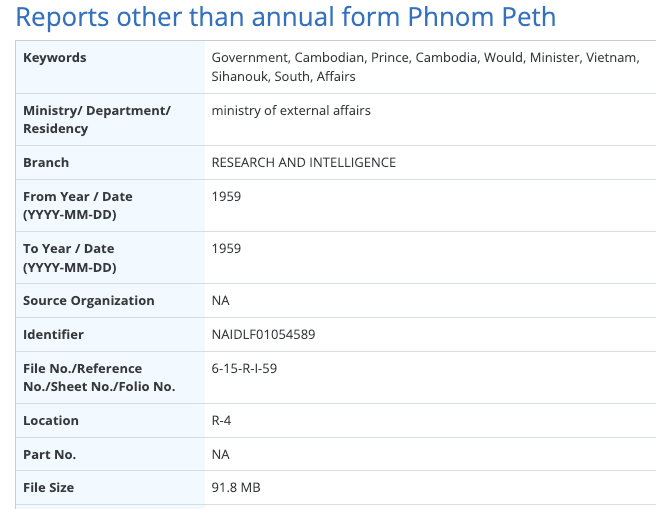
I’ve never figured out how to create a durable permalink to individual records, so I’ve copied screenshots below to help people find them. I’ve also included an excerpt of a summary of a conversation between Prince Sihanouk and Raghunath Sinha, the Indian ambassador to Cambodia at the time, in which Sinha expresses his concerns over his tilt to China.
Parts of a letter back to Delhi from the Indian ambassador:
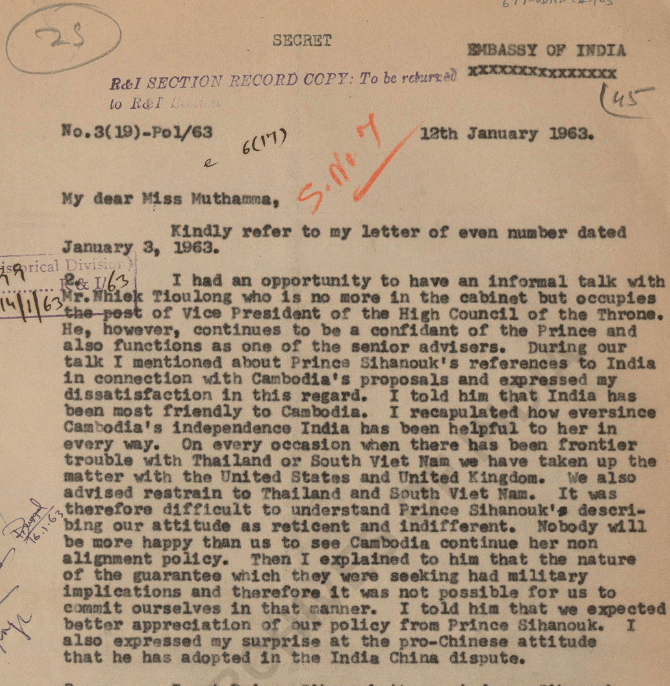
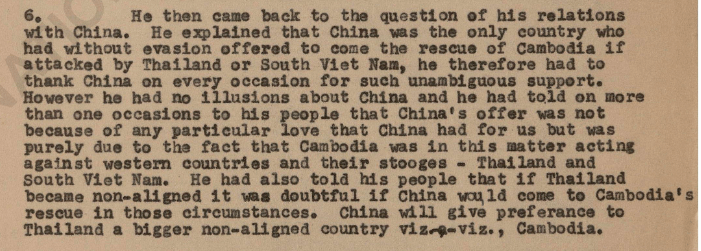

Some screenshots of the files themselves (note the incorrect title spellings – I think this is the AI/OCR at work, but it also OCRs the entire full text so searches go to the right files)

Akhilesh Upadhyay on US aid and Nepal
Akhilesh Upadhyay has a valuable piece in the Hindustan Times on the implications of radical shifts in US aid under the Trump administration:
“America partners with the Nepal government and local organisations on a wide range of programmes—from boosting food security and economic growth, managing natural resources, improving health care and education and bolstering democratic governance and responding to natural disasters. Nepal has been a major recipient of aid from the US, the largest donor globally. In fiscal year 2023, it disbursed $72 billion worldwide. . . .
Already, some organisations have been forced to lay off their staff while many others are bracing for a protracted suspension. The worst-hit are those which are fully funded by American assistance. But all — regardless of whether they are fully or partially funded — now seem pressured to diversify their resources. A senior member of a civil society organisation working on climate change said his office has laid off some of their Kathmandu-based staff, and the remaining members of the team have agreed to take a 20% pay cut to stay afloat. Efforts were now afoot to diversify aid sources.. . . Fast forward to 2022, USAID signed a five-year “strategic plan” with the Nepal government, committing $659 million. The agreement outlines the broad development areas of cooperation and collaboration and supports Nepal’s goal of graduating to a middle-income country, working in partnership with the government, civil society and the private sector. The emphasis is on strengthening democratic governance, enterprise-driven economic growth and increased resilience for communities most at-risk to natural disasters and climate change. But questions have arisen about whether Trump 2.0 has any appetite for these programmes, including the idea of inclusion, a cardinal political pillar of Nepal’s new constitution and polity post-2006. . . . .
By all accounts, however, the 90-day hiatus will not impact the US-assisted Millenium Challenge Corporation’s (“MCC”) Nepal Compact — the single largest grant Nepal has ever received. The aid is being used for building transmission lines and improving roads. Nepal contributes $197 million to the MCC Compact. If the recent statements from the U.S. government is anything to go by, MCC projects are not in danger. According to a January 26 statement by the State Department, Trump’s executive order “on Reevaluating and Realigning” the foreign assistance only covers those areas “funded by or through the State Department and USAID.” . . . .
For now, however, the suspension of US aid has sparked significant discussion on Nepal’s social media and in the press, reflecting public concern over the potential negative impact on essential services and development projects. Significantly, the recent shifts in American foreign policy have resulted in new small-state anxieties in Nepal, just as in Sri Lanka and Bangladesh, that far outweigh the development budget Trump’s move has put on hold. To many in Nepal, the possibility of the aid withdrawal by America, or ‘Third Neighbour,” could lead to even greater reliance on two immediate ones — India and China in the long term. America’s great-power rival, China might even relish this prospect in the South Asian theatre.”
 Paul Staniland