
Damselfly. August 23, 2025.
Srinath Raghavan is one of the great historians of contemporary India (and South Asia). His new book on Indira Gandhi is a must-read. But I also found a lot of value-added beyond the book in this great interview of him by Rohan Venkat on Rohan’s excellent India Inside Out Substack. Go forth and read the interview.
In the last blog post, I highlighted recent Pew data on Indian views of the United States and China. Today Pew continues its streak of important data about India and public opinion with views of India in a couple dozen other countries. One thing we want to be careful about is attributing too much to year-on-year shifts (surveys can be noisy, response rates can vary, etc) but it’s still interesting and worth keeping an eye on.
First, the overall favorables. I was struck by how evenly divided opinion in the US is (more below), and the lack of high favorables in Australia and South Korea compared to Japan and Indonesia. Not clear how much of this is signal versus noise, but interesting to note.

Second, change since last year (again, take with grains of salt):
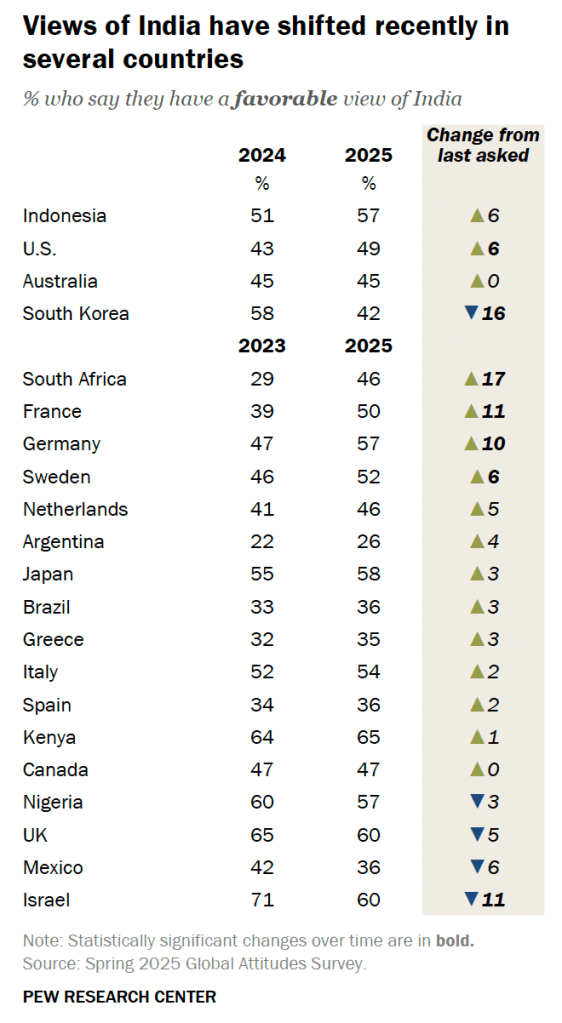
Third, after going through some gender and age splits, Pew notes that there isn’t a consistent ideological cleavage in views of India:

This speaks to questions about whether India is perceived more favorably by the Republicans in the US; consistent with my poking into the question way back in 2019, there is some evidence that the American left is more pro-India on aggregate than the right. Given the heightened anti-Indian sentiment (around H1Bs, for instance) in the Trump coalition, this should be little surprise, and certainly doesn’t suggest a strong pro-India mass constituency on the right.
Donald Trump’s approach to India over tariffs will be bad for US foreign policy. New Delhi will surely figure out a way to do business with the US in the coming weeks and years, but it seems pretty obvious that it will not be able to trust the US as a reliable strategic partner (at least, I sure wouldn’t). A wildly mercurial, punitive America is not going to reach its potential as a hub in an effective series of bi- and multi-lateral relationships in Asia. India has limited options since Russia is not a full substitute and China is at the end of the day a strategic rival, so I don’t expect it to break entirely from the US or anything. But New Delhi will likely see a lower ceiling on future cooperation with the US than in a counterfactual world in which this was all handled differently. And I say this as someone who has often been more skeptical than the conventional wisdom on US-India ties, so not a booster or someone whose professional status depends on an ever-improving relationship.
The particularly perverse aspect here is that Trump’s policies come at a time when the Indian public is (was?) notably pro-US compared to many other middle-income states. Pew just had a fascinating piece on views of the US and China in several such countries, and as of spring 2025, India was much less concerned about the US than its contemporaries:
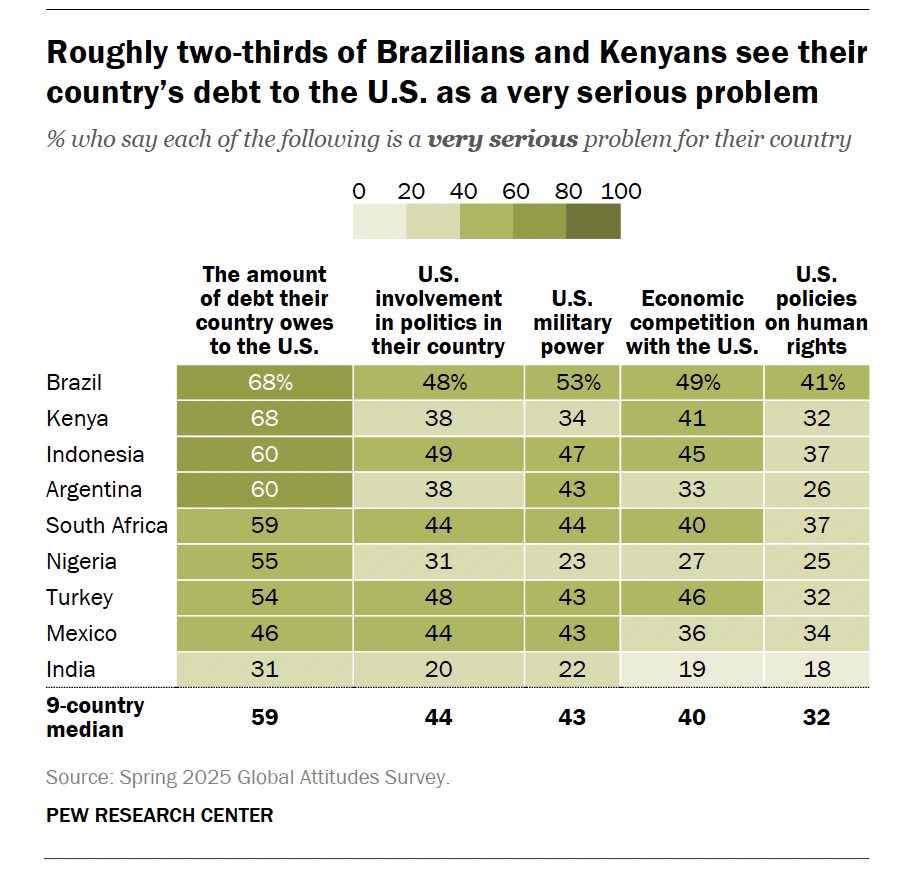
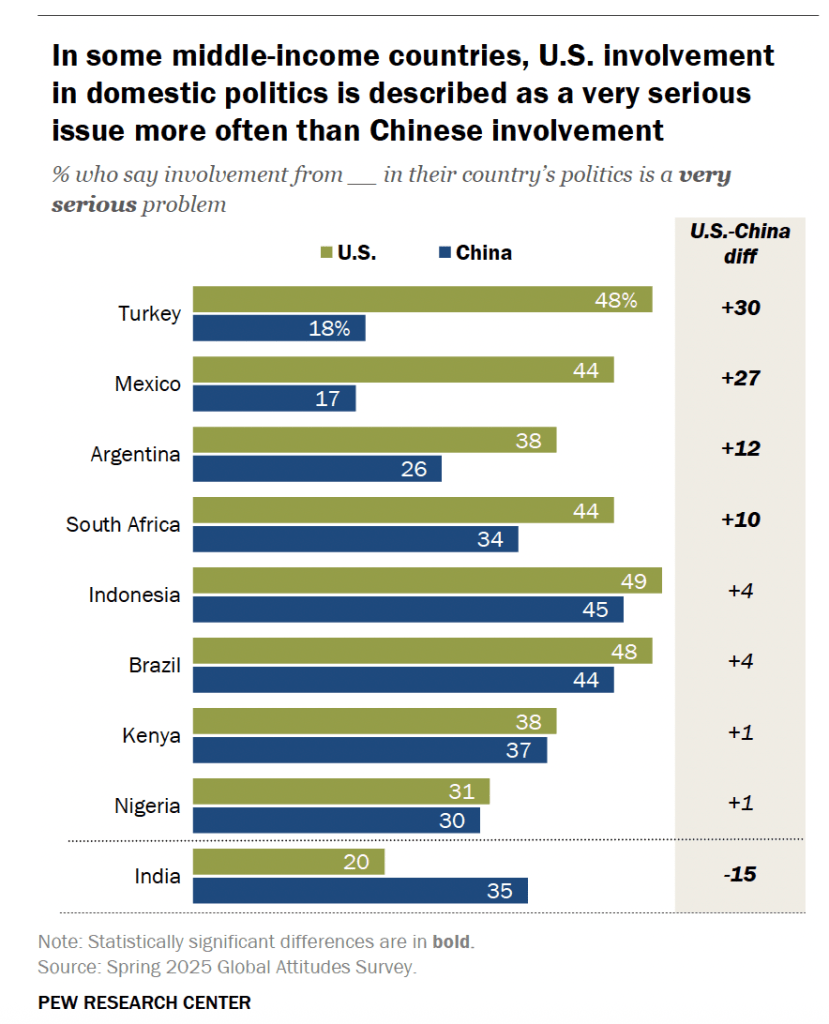
This is consistent with decades of survey work on Indian attitudes – often skeptical of particular US foreign policies, but quite positive at a broad level about the United States. It’s possible that this will continue, but the nature of Trump’s highly public, unambiguous denunciations of India – alongside his renewed ties with Pakistan – may trigger a serious drop in this sentiment. And all for no clear reason: it’s a gratuitously insulting, counterproductive way to run a country’s foreign policy, especially toward states like India that are not locked into being US protectorates like Europe or parts of NE Asia, and that have at least some room to maneuver in response.
 Paul Staniland