I somehow missed it, but in late April, Alex Thurston (of Cincinnati and Sahelblog) wrote a very thoughtful, careful review of Ordering Violence in e-IR. I thought it was excellent and am grateful for his engagement. Thurston got what I was trying to do, while also dissecting areas where the book falls short (primary sources, for instance – the project got so spread out and wildly sprawling that I ended up relying heavily on secondary accounts to try to even thinly cover the terrain). I am also always fascinated by how to think about political violence in sub-Saharan Africa; there are quite wildly divergent approaches to studying the region, some of which seem quite familiar, and others quite alien to my area of focus and worldview. Check it out.
Gwadar and CPEC
This is a very valuable overview of Gwadar’s development as part of the China-Pakistan Economic Corridor (CPEC). Some excerpts:
“
Gwadar processes almost no cargo that could generate income for Pakistan — or, for that matter, for the Chinese operating company. And it’s no wonder: Gwadar is operating at very limited capacity. The port’s three berths, where loading and unloading takes place, can handle 137,000 standard 20-foot shipping containers per year. In contrast, Karachi and its 33 berths can handle the equivalent of 4.2 million 20-foot containers per year.
While ports like Kribi or Lekki are comparatively small, they outshine Gwadar, the supposed new centerpiece of trade for South and Central Asia. . . .
Mardell and Khalid said that behind the scenes, both Pakistan and China have become disillusioned with the project.
“Jobs promises were not met. Industrial promises were not met. The business opportunities for Pakistanis were not met,” said Khalid. “They [China] promised nine special economic zones. Not one is fully functional to date.” . . ..
Still, countries like Pakistan are now stuck paying back large amounts of debt to Chinese lenders. “Pakistan has to pay billions of dollars back in loans, because of reckless investments in the name of CPEC,” said Khalid.”
Spring 2024. May 1, 2024.

The best *2nd* book on Indian foreign policy
For readers interested in Indian foreign policy, there is a growing array of valuable books. I recently read former Indian foreign secretary (and current IR professor!) Shivshankar Menon’s book India and Asian Geopolitics: Past, Present. I thought it was fantastic – really embeds India’s experience in the broader politics of Asia, presents an Indian perspective but does so in a very balanced way rather than cheerleading, and covers a remarkably wide range of topics and regions.
It’s also what I consider the best second-book-to-read on Indian FP. It assumes a certain amount of knowledge of Indian history, from the Emergency in the 1970s to balance of payments crises and the details of various wars and crises. Read something like Alyssa Ayres’ Our Time Has Come, Sumit Ganguly’s Indian Foreign Policy, or, for a broader overview, Ram Guha’s India After Gandhi first to get some basics down, and read Menon’s book next. And from there you can pursue more specialized books on a vast, ever-growing number of topics.
New article in Foreign Affairs
I have a new article out in Foreign Affairs on US strategy for competing over Asia’s “swing states” that draws on my current book project. (caveat: I didn’t choose the headline or sub-headings, which are a bit different than the actual argument, so please read the piece!). Some extracts below:
“Although China is undoubtedly more influential than it was three decades ago, the bulk of Asia’s states are not at risk of falling under China’s sway. Asian countries now boast complex and autonomous domestic politics that do not align neatly with either Chinese or U.S. priorities. At times, these countries are indeed gripped by internal debates about whether to align with China or the U.S. and its partners. But just as often, that debate is secondary or even irrelevant compared with these countries’ more pressing internal challenges and foreign policy goals. . . .
Asian countries’ politics and interests also do not map seamlessly onto the Biden administration’s autocracy-versus-democracy framing. Neither the Marxist-Leninist party-state model nor liberal democracy is clearly on the march in the region. Indeed, many regional states believe they can successfully balance ties with both sides as they forge their own forms of domestic politics. . . .
Washington will be most effective when it approaches Asia’s swing states as they are: complicated and autonomous countries, not pieces on a chessboard maneuvered by Beijing and Washington.”
Possible Myanmar trajectories
Myanmar’s military is increasingly losing control of key areas of its borders with Thailand, China, and India while continuing to face ongoing insurgency in “heartland” areas of the country: “the regime has lost its position as the dominant military and political actor in Myanmar. A more multipolar landscape is emerging.” IISS has a valuable map of the shifting, overall escalating violence. We may – or may not – be seeing a defining cascade against the regime, from Operation 1027 to the Arakan Army’s remarkable advances in Rakhine to the fall of Myawaddy to the KNU/PDF to KIA attacks in the north to CNF presence along the Indian border to the endurance of People’s Defense Force units across the country.
I want to use this post to sketch out some possible scenarios for where things go from here using examples from other civil wars, to help identify what policy questions people in and out of Myanmar should be thinking about.
- Regime renewal. This seems quite unlikely to me given the overall balance of forces and trends, but in the late 1940s/early 1950s in Burma and the mid-2010s in Syria, central governments looked to be hugely embattled. But eventually they were able to largely push their opponents back to the periphery and reestablish political control over most of the country. In Syria, this was accomplished with extraordinary bloodshed and Russian and Iranian external backing; in 1950s Burma, a mix of fighting, deal-making, and insurgent fragmentation was used to prevent regime collapse.
- Stalemate- disjointed. The insurgents consolidate control in various areas, and make some further inroads, but the regime remains cohesive, the military does not crack, and armed groups struggle to launch decisive offensives. We see enduring liberated zones that cannot be conquered by the regime, though conflict carries on, and that carry on de facto foreign policy with neighboring states. They are not well-connected to each other politically, and instead very regionalized. This bears some resemblances to Burma’s 1960s-1980s, before the wave of ceasefires and military advances of the 1990s, periods of 1980s and 1990s Afghanistan, and Syria in the mid-2010s.
- Stalemate – consolidated. In this variant, the areas of insurgent control become increasingly politically connected under an umbrella organization that can actually exert some degree of central control. The NUG would be the obvious potential central power here, though many crucial questions remain about when and how armed actors would actually relinquish control to an overarching power. At a stalemate stage, however, deep integration would not be necessary to coordinate across fronts – this is more about cooperation than about full organizational/political merger. This is a fairly rare outcome in 3+-party civil wars because of how difficult it is to integrate on the fly, but maybe the FMLN in El Salvador or some of the Ethiopian conflicts’ coalitions.
- Incremental regime contraction. This is a world that takes the last 7 or so months and continues to extrapolate it forward. The central government does not splinter, but local units are overrun, local defections occur, and the regime’s radius of control increasingly contracts. A new equilibrium may be reached along stable battle lines that represent a more insurgent-favorable version of the stalemate outcomes above, tilting the status quo against NPT. This would be like Laos and Cambodia in the early-1970s, etc – things not going well and territorial losses mounting, but a kind of fighting retreat in hopes of external intervention, rebel factionalization, or some other dramatic form of salvation.
- Bottom-up regime collapse. However, this process of contraction could spiral into a Cambodia 1975/Afghanistan 2021 type of outcome, with cascading local losses and side-switching aggregating into a dramatic shift in the balance of power and regime collapse as local units and mid-level commanders simply stop fighting. The nature of these wars can involve long periods of seeming-stalemate or incremental losses that then suddenly turn into dramatic and rapid collapse. I don’t have any confidence in my personal ability to predict when outcomes 2 and 3 would turn into 4, or when 4 would turn into 5, but we shouldn’t discount any of these possibilities: things can fall apart quickly when tides begin to turn. Given the nature of Myanmar’s war compared to simpler two-party wars, this could turn into a kind of highly decentralized landscape of different governing authorities – possibly turning into conflict or competition among them – if the opposition movement does not have some threshold level of political coordination and unity. The range here varies from “cohesive replacement of the regime and transition into a new political system” to “early/mid-1990s Afghanistan.”
- Top-down regime collapse. A final trajectory occurs via splits and ruptures within the military elite. This could simply shuffle the desk chairs of the military command, but it could also lead to fragmentation or conflict that opens space for the insurgents to make massive gains. In some cases like this, part of the elite cuts a deal with the insurgency to negotiate a transition, which would generate a fascinating and unpredictable bargaining process over a regime-change pact. This elite conflict could instead lead to spiraling state failure as waves of defection and desertion unfurl across the security apparatus, rather than laying the basis for a pacted transition.
If I had to bet money on this in the short-term (i.e. 2024), I think trajectory 4 is currently the most likely (regime continues to lose territory but without dramatic collapses), followed closely by trajectories 2 and 3 in that order. But that’s a very low confidence, short time horizon bet – outcomes 5 and 6 could certainly happen, possibly with surprising speed, and so could, though in my opinion with a very low probability, a return to regime dominance.
South Carolina sunrise. March 29, 2024.

STEM excess
This is a great piece by Paul Musgrave on the problems that have been created by the discursive dominance of “STEM.” Some excerpts:
-“Non-STEM disciplines must continually validate and justify their existence in ways that never occurs to STEM participants. If I were to assert that political science majors demonstrably out-earn biology majors, for instance, you’d think I was stark raving mad—but no, it is so. Political science majors similarly out-earn chemistry majors, and all three pale before econ majors.2 Yet even economics is not STEM, although it’s probably the most STEM-adjacent social science, and as such has no acronymic umbrella to shelter it.”
– “Students who have learned since preschool to identify planets and atoms are not introduced to similar vocabularies for understanding their society. “Interests”, “institutions”, “identities”, “norms”, “structures”, and the like are in fact real terms with real (if contested!) meanings that correspond to real phenomena in the world.3
Please bear in mind that I’m not talking about the value of the humanities. You may be eager to read this as yet another “oh the humanities!” plea. Don’t. This isn’t about the humanities. This is about the social sciences: the systematic study of and organized understanding of human activity and behavior, something as hostile to the spirit of humanistic inquiry as the study of electrons.”
– “Or, to finally bring us back full circle, it’s a calibration of institutions back to the tastes and preferences of one class—not, in this case, a revolutionary one, but the alliance of sensible centrists and C-suite denizens who define so much conventional wisdom. That’s not a coalition that Lenin would have dealt with (well, you know what I mean), but functionally it serves the same role: progress and productivity are fine, but challenges and critique are not.”
2022 was a bad year for political violence
The Uppsala Conflict Data Program tracks armed conflict and produces valuable annual overviews in the Journal of Peace Research (as well as ongoing data on their website, including charts I often use for teaching). There are important caveats about these data and various categories of conflict and coding that need to be kept in mind (information here), but I find them extremely useful in getting a sense of where the most violent conflicts are and how they are trending.
Their 2023 summary (Davies, Pettersson, and Oberg 2023) makes for some grim reading, which I suspect will not get any better when they release their 2024 summary later this year. Though policy interest in civil wars/internal conflict has markedly decreased, they remain extremely common and important, while classical interstate conflict is also reemerging as relevant.
Some of the key findings:
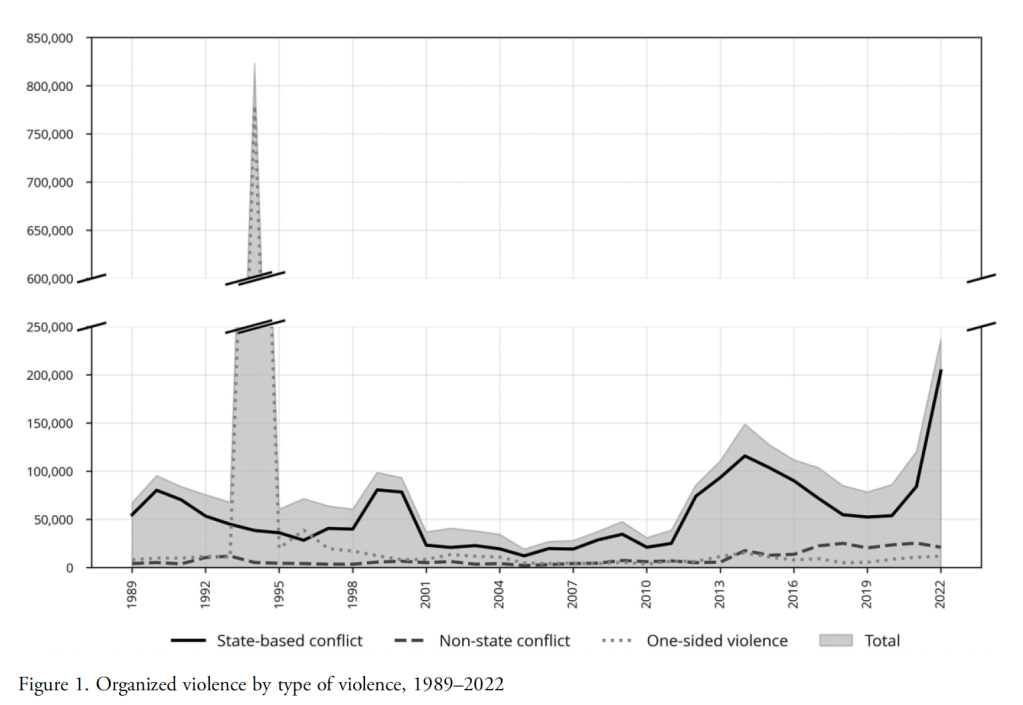
- “In 2022, fatalities from organized violence increased by a staggering 97%, compared to the previous year, from 120,000 in 2021 to 237,000 in 2022, making 2022 the deadliest year since the Rwandan genocide in 1994”
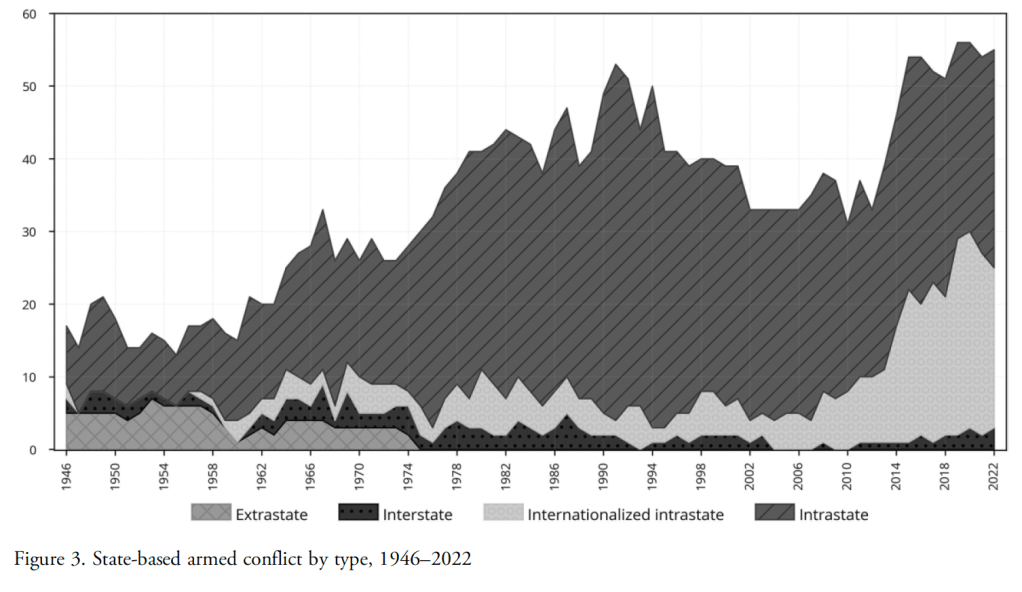
- “We have witnessed an emerging trend of increased conflict between states in the last decade, including cases where major powers support opposite sides in internationalized intrastate conflict”
- A chart of the number of conflicts:
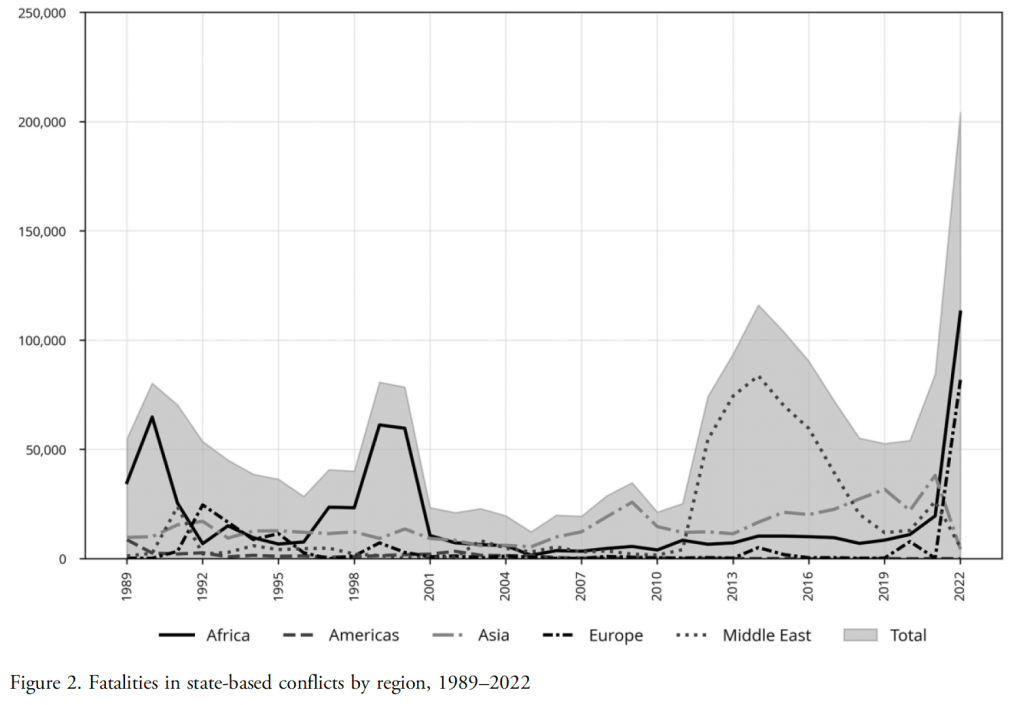
- A chart of the number of fatalities in state-based conflicts (i.e. government vs. rebels/factions):
- The continued dominance of Intrastate and Internationalized Intrastate conflicts among global conflict, though interstate wars continue to exist and matter:
- There is not great news on the “non-state conflict” front (i.e. conflicts among social groups, cartels, etc) either: “While the number of active conflicts increased from 76 in 2021, the fatalities caused by these conflicts decreased from more than 25,000 in 2021 to at least 21,100 in 2022. Yet, 2022 was one of the five most deadly years in non-state conflict since 1989, and the past nine years have witnessed unprecedented levels of non-state violence, as shown in Figure 4. Violence in Mexico and Syria has been driving this trend.”
Two interesting recent pieces re: Myanmar & Afghanistan
- Angshuman Choudhury on India’s (partially/potentially) changing approach to Myanmar in The Diplomat: “Vanlalvena’s meeting with the AA, which couldn’t have happened without some degree of approval from the federal government in India, shows that the needle might be shifting in New Delhi. There is now a subtle but certain recognition in parts of the Indian political and security establishments that the SAC is losing Myanmar rapidly. This is especially true for western Myanmar – Rakhine and Chin States – where the AA, Chin National Front/Army (CNF/A) and other Chin armed groups have made sweeping territorial gains since October when the Three Brotherhood Alliance launched coordinated offensives against junta targets in the north.”
- Asfandyar Mir and Andrew Watkins on regional engagement with the Taliban in Foreign Affairs: “Two and a half years into Taliban rule, however, the United States has little to show for this approach. For one thing, the Taliban appear to be unmoved by global shaming,. . . . The U.S. approach is also struggling because a growing number of governments, such as China’s, are not treating the Taliban as a pariah regime. . .Nonrecognition is no longer a credible coercive tool, and if the United States seeks to influence Taliban behavior, it must find other ways to achieve its desired aims.”
 Paul Staniland