Blog

Mathieson on the “Burma gap”

David Scott Mathieson’s piece on the remarkable paucity of research on civil conflict in Burma/Myanmar within the study of civil war is a must-read:
“There is lamentably little known about the history of the civil war or about the micro-dynamics of conflict. It begs the question: why is Burma almost totally absent from the academic and reportage canon of conflict literature? In academic research and related human rights documentation and journalism, there is generally only passing mention of Burma’s conflicts within historical and academic surveys of civil war.”

And to bolster his point – even if we accept that there are serious problems with quantitative data on Myanmar, in the current UCDP/PRIO Armed Conflict dataset, almost 12% of the entire dataset’s dyad-year observation occur in the country.

Managed democracy

This is a great piece by Reuters on the Pakistani military’s kneecapping of a free media:

“After Geo TV, Pakistan’s most popular station, was taken off the air across much of the country at the end of March, military representatives pressed the channel to cease favorable coverage of ousted Prime Minister Nawaz Sharif and stop any criticism of the Supreme Court and the “establishment”, according to the two people, who had knowledge of the negotiations.

The “establishment” is a commonly used euphemism for the military in Pakistan.

Written instructions by Geo management to staff last week that were reviewed by Reuters spelled out “key editorial points that we have to manage and implement” to be restored to the airwaves.

Besides banning negative portrayals of the “establishment” and any allegations the Supreme Court might be interfering in politics, the instructions said there should be no reports on Nawaz Sharif’s ongoing corruption trial “that helps build a narrative that he and his children are innocent”. . . .

Three major cable operators, who spoke on condition of anonymity, earlier told Reuters they had pulled the channel from their rosters after direct instructions from unidentified military officers, even though the army has no official authority over the media. . . .

Five of the Geo insiders said they knew the widespread cable blackout was a result of military pressure. However, only two were willing to talk about the conditions laid out by military officials to Geo for restoring the channels, and they said they were doing so against direct orders from the company’s owner.

One executive at a leading cable company that covers more than a million households in Pakistan told Reuters he received a telephone call at the end of March from a senior officer in the ISI telling him to take Geo TV off their roster. . . ..

There was never any question of refusing the order, he said.

A second cable executive said his company shut down Geo broadcasts after receiving a telephone call. Asked who made the call, he said: “I can’t say the name, you know, big brother, the boots.””

Threat Perception among Hindu and Buddhist Nationalists

In South Asia, we currently see anti-Muslim violence in Sri Lanka, anti-Rohingya violence in Myanmar (alongside fears of its spread to the broader category of non-Rohingya Muslims), and the ongoing rise of Hindu nationalism and its project of making Muslims second-class citizens in India.

I worry deeply about these movements and their frequently lethal and profoundly undemocratic consequences; their politics are very distinctly not mine.

But I also think Western analysis (especially press coverage) of these movements sometimes misses a key aspect of how they see themselves – as defensive projects provoked by expansionistic, proselytizing religions while being subjected to the hypocrisy and double standards of bien-pensant elites. The Myanmar case has been particularly striking – the anguished cries of Western elites about Aung San Suu Kyi do not appear to have any resonance in contemporary Myanmar. Similarly, hand-wringing about Narendra Modi and decades of condemnation of Sinhalese Buddhist nationalism in Sri Lanka have had a distinctly limited influence on these movements. We need to better understand why.

This is an admittedly impressionistic, overly simplified summary of what I take to be key elements of the threat perceptions of these movements. Christianity and Islam are seen as offensive, aggressive forces that tend to take and seize land that once belonged to indigenous religions. They then demand an unearned indigeneity, asserting their total claim to the conquered territory. Non-proselytizing religions like Hinduism and Buddhism find themselves ever more squeezed and restricted, unable to take back what was rightfully theirs. This is, for instance, part of the Hindu right’s narrative on Kashmir – rather than a Muslim territory that needs to be in some way accommodated as special and different, they frame it as a formerly Hindu territory seized and colonized by Islam.

This fear of permanent loss was perceived as coming from both Islam and Christianity, but has diminished toward the latter since de-colonization (though paranoia about conversion and missionary activities endures). Islam has taken on the role of most insidious enemy, with the shadow of past invasions and perceived demographic subversion operating powerfully in the rhetoric of these movements. Yet they believe that concerns about Muslim expansion are dismissed as Islamophobia by culturally (if not religiously) Christian Westerners and their local Anglophile allies (this is how the Indian National Congress, and especially Nehru, are portrayed), who they see instead retreat to wishy-washy talk of syncreticism and voluntary conversation rather than confronting historical realities of Islamic expansionism. This has particular resonance in the context of India, where Muslim conquests were followed by Christian colonization.

Fear – no matter how exaggerated or inaccurate – about birthrates and migration combine with the sons of the soil dynamics I identified in the previous paragraph (which, ironically enough, also applies to the Muslim Malay majority of Malaysia) to drive a fierce reaction against what is perceived as an existential threat – “the Muslims” will spread, procreate, and never go “home.” In this narrative, though Muslims can always go to the many majority-Muslim countries in the world, there is, by contrast, nowhere for the Sinhalese or the Bamar or Hindus to go in the face of this tide. Better to stand and fight, angry editorials in the New York Times or The Hindu or not. Indeed, there is deep resentment of press coverage because they believe that coverage of Islam are driven by “minority appeasement” (a favorite Sangh Parivar phrase) for fear that Muslims will raise havoc, while the Hindu nationalists are relegated to the un-nuanced status of lumpen mob and Rakhine Buddhists to hate-filled genocidaires. Against the claim of many that Islamophobia dominates media coverage, these movements see a craven press relentlessly biasing its coverage toward Muslims.

To go out even further on a speculative limb, this is one of the reasons that many in India’s Hindu right so enthusiastically admire Israel. It is the state of a non-proselytizing religion that is nevertheless willing – and able – to unapologetically take back land seen as stolen from it, in the process denaturalizing the Muslim nature of the land in question. There is no scraping and bowing to the hypocrisies of the West or an intrinsically expansionistic Muslim world; instead, they see assertion, strength, and unity. As Jaffrelot has argued in great detail, there is a powerful strand of emulation in the Hindu nationalist movement, and we see it here too.

This does not mean analysts need to accept any of these claims, to discount the blood and terror that these movements have so often spread, or to believe they are not frequently just a cynical shield for the exercise of power. Rather than an oppressed minority, these movements have often acted in reality as a springboard for majoritarian dominance. Moreover, these dynamics are not unique to these movements – the same language that extremist Sinhalese Buddhists now hurl against Muslims has also been deployed against Tamils.

But not taking these perceptions seriously – especially the belief that Buddhism and Hinduism have a kind of “cap” on their numbers while Islam and Christianity can always add to their ranks through proselytization – as a political force will continue to lead to the analytical gaps and misfires that we have seen in many assessments of the politics of Myanmar, India, and Sri Lanka. These are ambitious political projects with goals of political hegemony, fueled by a narrative of fundamentally defensive victimization from without. And they aren’t going away anytime soon, I suspect.

After the Doklam euphoria

After India held firm in the Doklam stand-off last year, there was a spate of excitement among some pundits, politicians, and optimistic analysts in India (and DC).

But a certain degree of sobriety has returned in recent weeks, especially in the wake of bad budget news for the Indian armed forces (here’s the report). For an overview, see pieces by Srinath Raghavan, Pratap Bhanu Mehta, Abhijnan Rej, Sushant Singh, numerous pieces by Ajai Shukla, Laxman Behera, and even Shiv Aroor. I chimed in with a broader piece on the limits of Indian military power in War on the Rocks that included deep concerns about the budgets underpinning India’s military rise.

Trump and American Politics

I inadvertently triggered an interesting Twitter conversation the other day. I’d been following the Corey Robin-Levitsky & Ziblatt-Jeff Isaac debates about authoritarianism and the US. I tweeted that a lot of very prominent Americanists don’t seem to have publicly weighed in much one way or another about whether we should be sanguine about Trump or not (Nathan Kalmoe and Jonathan Ladd interpreted this to mean I said no Americanists had ever said anything about Trump – I meant it to focus on the democratic stability question (per Brendan Nyhan); mea culpa if an inaccurate larger claim came across).

I actually thought this would lead to Americanists weighing on whether they thought these arguments were missing the mark (as Matt Grossman later did very valuably, arguing that “status quo expecting area studies specialists (Americanists) are more on target on Trump admin” than the non-US specialists), but it didn’t go that direction.

There were instead three very different reactions, all of which strike me as having real merit – but which also can contradict one another. I was off at the Field Museum for the majority of it and things kind of got away from me, but I’ll try to summarize the basic responses since I think they say interesting things (apologies if your involvement wasn’t noted!). Thanks to everyone who participated – maybe Twitter is more than just a total time sink.

Americanists Can’t Say Much about Trump (at least without comparative data)

The first set of responses agreed with my premise and suggested that Americanists aren’t well-positioned to study key debates around Trump because the relevant data is comparative. Jeffrey Lax wrote that “I think it’s because there is less to say if you study even somewhat “normal” AP. This is off the charts, so it speaks well that many aren’t extrapolating beyond what they study. Some know more & say more. CP more relevant to lots of current ?”.

Brendan Nyhan – who has been very vocal indeed about dangers surrounding Trump – wrote that, while “we can draw on topics listed above in American but whether they cumulate into threat is harder to answer w/just US.” Julia Azari suggested that “the relevant data for a particular kind of argument is non-US – institutional erosion and authoritarian rhetoric.” And Pippa Norris jumped in to argue that “I suspect Americanists lack the conceptual tools to handle this phenomenon”. W.K. Winecoff argued that “Comparativists think about qualitative variation in political institutions. Americanists mostly don’t, because (for the things they mostly care about) there hasn’t been any.”

Some Americanists Can Speak to the (Possible) Dangers of Trump, but Others Don’t Have Much to Say

Another set of respondents agreed with the general claim that a lot of Americanists are keeping their heads down, but suggested that some Americanists can speak credibly to key fears about Trump. A number responded that I was overlooking the public engagement of scholars associated with American Political Development (APD) and Race, Ethnicity, and Politics (REP) – Vesla Weaver, for instance, pointed to Theda Skocpol, Jacob Hacker, and Paul Pierson as prominent voices. Several pointed to a working paper by Robert Lieberman, Suzanne Mettler, Thomas Pepinsky, Ken Roberts, and Robert Vallely (which I mentioned on this blog). Rafael Khachaturian suggested that “AP has never come to grips with an unspoken exceptionalism about the society it studies.”

Corrine McConnaughy pointed to the neglect of REP by the “mainstream” of political science – “It is considered “niche” in political science when it is not actually “niche” in American politics. Hence those of us who do that work have a differently informed take on “American politics” – one that that this moment ought to be making use of.” Kimberly Johnson argued that “Some of us @ the intersection of Race & APD saw this.” Laurel Eckhouse indicated that “mainstream Americanists often ignore serious historical threats to democracy in the US, esp treatment of black activists/voters.” Rob Mickey suggested that there is a kind of assumed-stability bias in the study of American politics.

The basic claim here is that the mainstream of the field ignores many of the nastier and more problematic aspects of the American historical experience (especially as related to race), which leaves it unsure how to deal with authoritarian-tinged demagoguery and threats to basic institutional integrity.

Elizabeth Cohen also pointed out another set of political scientists who have something to say about the present moment – political theorists, including “Alison McQueen, Chris Lebron, Katrina Forrester, Corey Robin, Jason Stanley, Ekow Yankah are just a few names of theorists taking on contemp politics inc but not limited to Trump and doing so in very public venues.”

Paul, what are you talking about?!?!

The third response was dramatically more skeptical of the original premise. Jonathan Ladd pointed to forthcoming work on these issues. As noted above, Nathan Kalmoe thought I was over-claiming from the beginning.

Adam Berinsky (whose In Time of War I recommend in the strongest terms) offered the most sustained critique. He argued that “the assumption that am politics scholars are not engaged is flatly wrong” and that many Americanists are deeply involved in contemporary politics, even if it’s not publicly visible: “Is it more valuable for me to talk to members of multiple branches of the us govt and tech companies in an informed in depth way about the implications of my research for information transmission or get on a soapbox?” and “Smart people in industry and government are interested in serious research. And I am only one of many Americanists talking to them.”

He further argued that critiques of the subfield emanating from REP and APD (i.e., the claims in the previous section) are “taking a provincial position as well.” Berinsky pushed back (about which I agree with him) against the idea that public engagement/studying important topics is intrinsically in conflict with using sophisticated methods.

This led to some pushback in turn by Dan Nexon and Julia Azari, who didn’t love the use of “soapbox” (which I also agree about). Mike Horowitz offered a broad and useful way to think about policy relevance. There’s a lot worth taking very seriously in Berinsky’s critique of my (rather more limited than it may have come across) critique.

What do I make of all of this?

I’m not 100% sure how to parse this as an outsider who was expecting a radically different set of discussions – some Americanists (and non-Americanists) argued Americanists can’t fully engage on big Trump questions, others argued that a small subset are (mainly drawn from REP and APD) but the mainstream was “unprepared” for Trump, and yet others argued that Americanists are in fact broadly engaged, in a wide variety of ways (some visible, others not), with the issues of the present. Some of this disagreement seems to be based on visceral and hard-to-adjudicate disagreements about what is, and should be, the center of intellectual and political gravity in the study of American politics, and I don’t see any easy resolution to that kind of debate (if it were up to me, American politics research would be exclusively about right-wing militias, leftist radicals, the FBI, security state surveillance, US defense politics, prisons, and the police, which I fully acknowledge would be ridiculous).

An argument that might be able to partially bridge some of the gap, however, also came up – my original tweet had in mind the kind of super-senior people with chairs at ultra-elite universities who you’d (or at least, I’d) expect to weigh in on a fundamental question like “Is America at risk of authoritarian backsliding?” That wouldn’t be soapboxing, but instead offering to the public the best, social scientifically-informed answers to a pressing and scary question (note: comfortable and secure academics on Twitter mocking political actors who have actual skin in the game doesn’t quite count, as much fun as it is for all of us).

Naunihal Singh instead remembers that “[Ken] Shepsle disdained engagement with “politics” & the Harvard Americanisms [sic] of that generation agreed & tried to inculcate that approach. Our generation is different, but I think there is a legacy.” Nyhan agreed but also pointed to important, commendable changes over time: “True that older gen of Am pol folks stepped away from public life [he links to a New Republic article from the 1990s]. . . .but I think those impressions are out of date.” Azari pointed to the online public sphere as a way for various kinds of scholars to engage, many of whom do; Berinsky argued it was “time to update.”

So maybe that’s part of what’s going on, in addition to deeper and enduring intellectual disagreements – shifts over time that lead to conflicting visions of what the level of public engagement actually is. Anyways, a fascinating set of discussions at an important time.

P.S. a thread that indirectly emanated from mine led to an interesting thread by Joe Soss, including the following:

“Scholars of race and US politics have been writing for decades about authoritarian modes of governance, the easy blending of law-and-order politics with official-led lawlessness, willingness to undermine liberal-democratic institutions to achieve repressive ends… 2/n

and their connections to xenophobic and racist strands of US politics. All along the way, such scholars have argued that their insights tell us something quite general about US politics, governing practices, and their future possibilities 3/n

And most of the time, the broader discipline of pol sci (like discussions of US pol in general) have treated these studies as a sidebar to the “real story” of American democracy. The experiences of subjugated groups (racial and otherwise) were treated as important, yes… 4/n

but ultimately distinctive in their departure from the main story of how US politics really works. Such studies illuminate a story of exclusion from the liberal democracy that is US politics, not a key and defining element of US politics itself. 5/n

So, many of us have seen something pretty familiar (and bitter) in the great wave of writings suggesting that, to make any sense of our ugly political moment today, we all must look outside the American experience. This is the point that began this exchange. 6/n”


Prashant Jha on the neighborhood

A useful overview of the challenges India faces in its neighborhood:

“What is India’s key problem in the neighbourhood today?

It is simply that even though Delhi believes having friendly regimes is indispensable for its security, it has not been able to shape domestic political outcomes in key neighbouring capitals as it desires; where it has succeeded in doing so, the situation remains fragile; and Delhi’s favourite political allies are ranged against Beijing’s preferred political allies.”

Are Indian security force casualties martyrs?

A recent RTI case in India asked whether the Ministry of Home Affairs and Ministry of Defence use the phrases “martyrs” or “shaheed” in official terminology. MHA and MOD both responded that this is not official usage:
“”The respondent from the stated that word ‘shaheed’ or ‘martyr’ is not used by the MoD. Instead the one used is ‘battle casualty’. The respondent from the Ministry of Home Affairs stated that in the MHA the word used is ‘operations casualty’,” Azad said.”

It’s worth noting, though, that the CRPF, BSF, and MHA use “martyr” in their website lists of killed-in-action (which Drew Stommes and I are just about done putting into dataset form). Not a particularly important issue, but worth noting the disjuncture between official bureaucratic policies and the actual languages of politics that those institutions use.

New working paper with Matanock

Aila Matanock and I have a new working paper out (link here for PDF).

Abstract
“Armed groups engage in elections in many regimes, and, in doing so, they pursue a surprisingly diverse array of electoral strategies. In this paper, we explore the strategies that armed actors seek to change electoral politics, and we identify four distinct electoral strategies by armed groups, compared to nonparticipation. We theorize that the specific dimensions on which participation types differ are directness, i.e. whether or not the armed group runs its own candidates in elections, and openness, i.e. whether or not the armed group makes official statements expressing electoral positions publicly. The strategies include openly fusing bullets and ballots to form an armed political party, controlling a political wing that stands candidates in elections, openly targeting particular parties or politicians, and secretly providing resources for separate parties. In contrast, some groups choose instead to target all parties and politicians or ignore electoral politics. Beyond laying out this new typology, and providing examples, we explore a first important question in this research area: why groups pursue different strategies. We argue, and show evidence in diverse case studies, that the support and cohesion of the armed groups, government tolerance, and party cleavages drive armed actors’ electoral strategies.”

When did which insurgency start? And was it Marxist?

I’ve blogged in the past about the challenges of both qualitatively and quantitatively measuring civil wars and “armed politics.” Right now, I’m having fun with cross-national civil war datasets as part of a project on leftist insurgencies in democracies (mixing Sri Lanka JVP micro-data with cross-national cases). Which requires figuring out which insurgencies were leftists, when they started, and which regimes were democracies in what years. I’ll bracket the latter question (anyone who’s tried to figure out what 1950s Pakistan counts as will be familiar with the vexations that can await).

I’ve been focusing on South and Southeast Asian cases, with Latin America up next.

Why can this be tricky? Well, take the Communist Party of Thailand (CPT). Much of the literature says it began in 1965 and Kalvyas and Balcells (2010 – data and appendix linked to here) code 1966 – but UCDP says 1974 was the year of onset. The Polity regime score of Thailand in 1965 is -7 (autocracy), but in 1974 it’s +3 (some kind of partial democracy or anocracy or whatever you want to call it). So the year of onset matters hugely if you are trying to figure out whether this was a revolt against a democratic-ish regime. Plus, telling a Thailand expert that the CPT revolt began in 1974 would probably be met with a incredulous look and then a dismissive eye roll about quantitative American social science.

Thomas and Wood (2017 – data here) code the CPP/NPA insurgency in the Philippines as a Marxist rebellion, but don’t list the 1946-1954 Huk rebellion because they focus on post-1979 cases. Kalyvas and Balcells (2010) agree on the CPP, but explicitly code the Huk uprising as a non-Marxist rebellion – even though many case experts would say was a Marxist insurgency. So who knows what the Huks were – do they count, or not? I’d say yes, but it’s a judgment call rather than a straightforward exercise.

UCDP says the CPP/NPA began in 1969 but Kalyvas and Balcells (2010) say 1972. Only three years off – but the Polity score of the Philippines in 1969 was +2 and in 1972 it was -9 (Marcos’ dictatorship). Either the CPP/NPA took on a semi-democratic regime – or it rebelled against a deeply authoritarian government (a similar quandary as with the CPT).

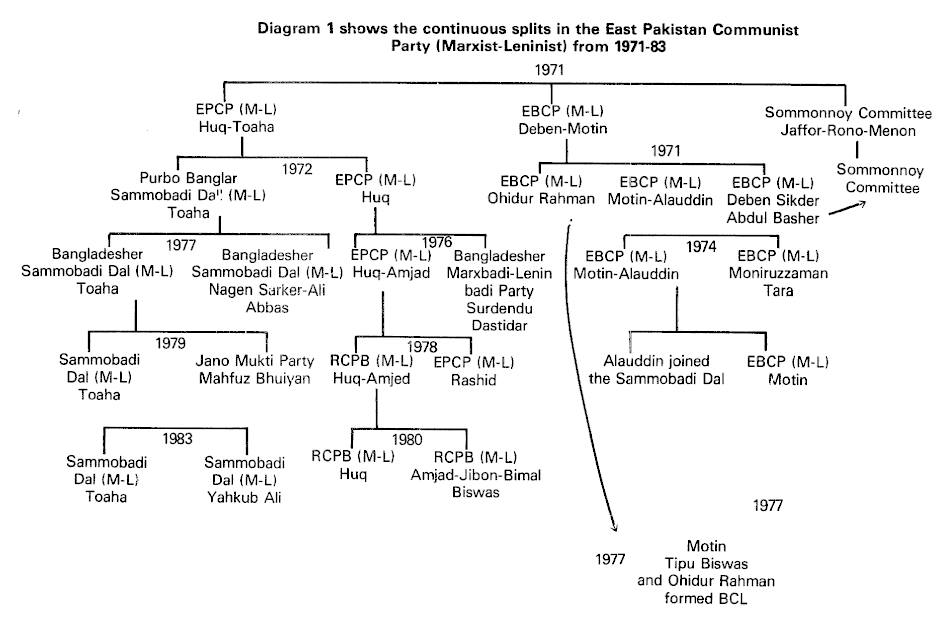
UCDP doesn’t have anything for Bangladesh in 1972-1974, when it was coded as an 8 in Polity (highly democratic). But the case literature points to the Jatiya Samajtantrik Dal (JSD) as a leftist insurgency during precisely this period. So if we put the JSD in, we have a leftist insurgency against a democracy. If we follow UCDP, there is nothing to see here. Once we add the Maoist Purba Banglar Sarbahara Party (PBSP) during the exact same period (the chaos leading up to Mujibur Rahman’s assassination in 1975), things get even wilder – not in UCDP, but definitely in case literatures. And both are leftists, but don’t appear in Kalyvas and Balcells (2010). We don’t know how many people (sources say things like “over two thousand”), or at whose hands, died during this period, so it’s little surprise it hasn’t shown up in datasets. But that doesn’t mean it didn’t happen or definitely doesn’t meet the relevant coding criteria.

India’s Naxalites are coded as getting going in 1969 in UCDP, 1967 in the case literature, and 1989 in Kalyvas and Balcells (2010, see Table A3). So either at the passionate height of Sino-Soviet split in the international communist movement – or in the final year of the Cold War when the whole Marxist thing was going out of style.

UCDP says the second JVP revolt in Sri Lanka kicked off in 1989. But the case literature and Kalyvas and Balcells (2010) say 1987. Who cares about two years? Well, Sri Lanka in 1987 was the year of the arrival of the IPKF, JR had been the president for a decade, and there hadn’t been a parliamentary election since 1977. In 1989, Premadasa was president, the IPKF was starting to back for the exits after having been around for a little while, there was an early-year parliamentary election – and the JVP’s strategy was totally different than in 1987. In 1989, it’s total war, total onslaught especially by the summer, targeting especially the security forces. In 1987, it was a much more selective focus on the UNP cadres while leaving open the possibility of some kind of deal (on JVP take-over terms) with leftist mainstream political forces. So your story about onset in 1989 would have to be very different than for 1987.

To be clear, there is also a ton of important agreement across datasets and case literatures. Everyone agrees that the CPB began its revolt in 1948 Burma, that the CPN-Maoist started its rebellion in 1996 Nepal, the Huks in 1946 Philippines, and the first JVP revolt in 1971 Sri Lanka. And many of the disagreements come down to specific, defensible coding criteria that come with many good things (UCDP knows its emphasis on verifiable battle death thresholds will lead to undercounting of particular types of phenomena, for instance – it’s a trade-off with the clear upside of comparability across cases). And I’m using all of this stuff for my more medium-/small-N-ish research project.

So this isn’t a cri de coeur against cross-national datasets, at all. But since we’re not dealing with many cases and we are grappling with very complicated questions, getting under the dataset hood is really important. Pulling stuff off the shelf to mix-and-match, by contrast, may not always be wise, since coding decisions can have inferential consequences.