Blog

US ambassadors squabble, 1958 SE Asia edition

In 1958 (and afterwards – things would get very bad in 1959 for instance), Cambodia had tense and conflictual relations with South Vietnam. Within this context, an exchange of cables in July 1958 provides a great example of US ambassadors in rival capital cities taking sides against the other’s country.

First we have Carl Strom, US ambassador to Cambodia, frustrated with South Vietnam and US policy toward it:

Phnom PenhJuly 7, 1958—5 p.m.

30. It is difficult to sort out the many things that have happened last few days but one fact seems to emerge prominently, namely, that Cambodia is at a crossroads. I am convinced Sihanouk has wanted and still wants a solution of his problems with Vietnam through the instrumentality of Western powers. Considerable evidence is accumulating that he is playing with the idea of support of some kind from Red China but I am still sure he believes that Cambodia’s true friends are in the West and that a closer approach to Communist bloc would be basically distasteful to him.

However, Sihanouk feels put upon and abandoned. He believes that Cambodia’s Western friends have been indifferent in his time of trouble. .. .

The solution of this problem would clearly seem to be settlement between Cambodia and Vietnam. This is desired by all the Western powers represented here, US, UK, France and Australia, and certainly by Cambodia. Sihanouk seemed to have removed the greatest difficulty, namely the question of who should make the first approach, by volunteering to go to Saigon. However, after having been told he would be received, whole project fell through as result bitter and vicious attack on Sihanouk in semi-official Vietnam Presse July 3.2GVN Foreign Minister issued official communiqué July 6 whose first paragraph was mollifying in tone but which in its effect did not improve situation (Saigon’s 31 to Department).3

I have twice recommended US intervene in strong and unequivocal fashion with GVN to require them to settle their difficulties with Cambodia.4 Department has replied that US cannot tell GVN what to do.5 However, in absence firm action by US, GVN has acted and, in effect, established policy for West vis-à-vis Cambodia which is exactly contrary to policy desired by all Western powers represented here. Even if negotiations can be rescheduled, they will not succeed unless Diem can be persuaded GVN’s self-interest makes success desirable. I [Page 235]do not believe we have any choice except to present matter to Diem as vital to his own interest and to that of West and to insist on negotiations with Cambodia in good faith.”

Then Elbridge Durbow, ambassador in Saigon, fires back:

SaigonJuly 9, 1958—7 p.m.

60. Following are my considered comments on Phnom Penh’s telegram 302 as requested by Deptel 36.

From here Cambodia does not appear to be at crossroads but rather somewhat past that point along road to left. Sihanouk has already recognized USSR and accepted Soviet aid and for most practical purposes has also recognized Communist China by accepting trade mission and considerable ChiCom aid. . . .

I translate Sihanouk’s talk about “pure” neutrality and “active” neutrality as nothing more than “pure” opportunism or smokescreen (see Phnom Penh’s telegram 27 numbered paragraph 5).4

To me Sihanouk’s talk about friends and allies in his July 5 speech is nothing but a part of smokescreen or crude blackmail attempt and his remarks accusing us of sabotaging his meeting with Diem are insulting and call for very sharp protest. . . .

Although I have repeatedly urged Diem and other GVN officials to exercise restraint and moderation in dealing with Cambodia and they have not been helpful, particularly in July 3 and 4 press articles,  I have personal conviction that Sihanouk for whatever motives he may have has deliberately elected to exacerbate Cambodian-Vietnamese relations and that time has clearly come for us to call his bluff. . . .

If Cambodia wants to turn increasingly to Communist China that is her privilege but RKG must not expect us to enter bidding contest with Communists but rather must expect that US would be obliged to re-examine its aid policy. We should also talk to Diem firmly along lines 1, 2 and 4 above.5

If, as may be case, Sihanouk is drifting more and more towards Communist China any efforts to appease him will only encourage him in his game of playing both ends against the middle. On the other hand if we bring him up abruptly I think we have a good chance of making him face situation with greater realism.”

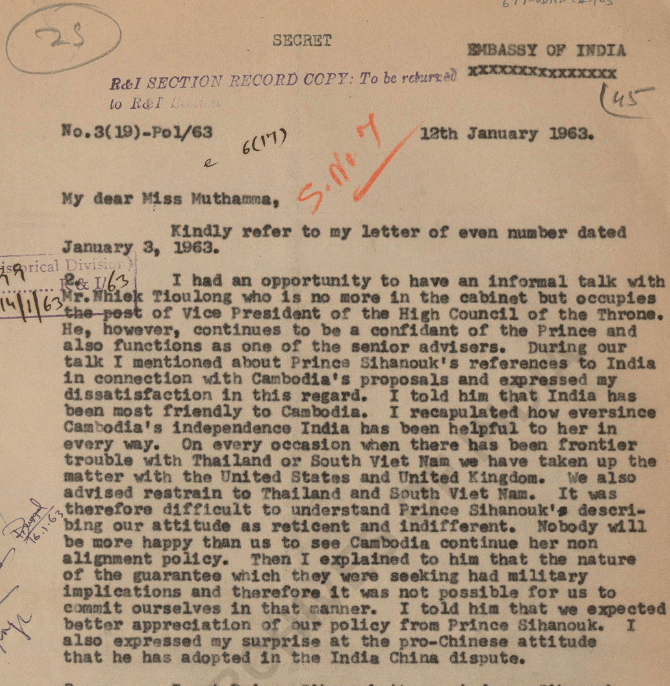
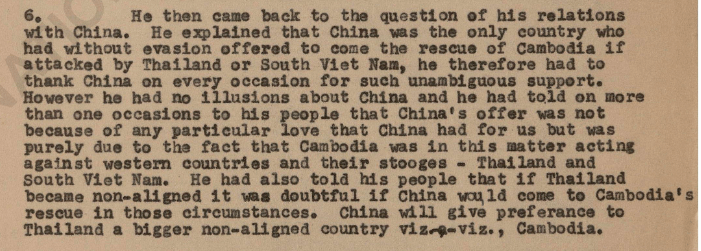
This tension about how to approach Sihanouk’s neutralism in Cambodia would be recurrent over the next decade, with sympathizers of his plight urging flexibility and understanding, and skeptics viewing him as tilting to the Communists (especially the Chinese) and being only encouraged by American understanding.

Tarapore on the “Long Shadow of the Ladakh Crisis”

Arzan Tarapore has a valuable analysis of where India-China ties stand now, and what choices present themselves to India now that there has been some measure of stabilization in the border dispute:

“The lasting impact of the Ladakh crisis should be measured in three dimensions. First, the crisis compelled India to intensify its military balance on the Line of Actual Control, but it remains unclear whether that has strengthened its conventional deterrence against China. Second, the crisis compelled India to reinforce its northern border at the expense of military modernization and naval force projection in the Indian Ocean. It remains to be seen whether that change will be reversed. Finally, the Ladakh crisis cratered India’s relationship with China and nudged it towards closer cooperation with the United States. The trajectory of India’s relations with both Beijing and Washington also remains an open question.

In each of these dimensions, the effects of the crisis between India and China that began in 2020 will be felt for many years.”

The upsides of India-US tension

India’s ruling party, the BJP, has launched a full-throated attack on the US State Department as being part of a Deep State plot to undermine the Modi government. This has definitely raised some eyebrows, since parties don’t launch these kinds of attacks without go-ahead from their top political figures. As with Imran Khan’s denunciations of the US in his case, in some ways the important thing is less the truth of the matter than the signals being sent and the political dynamics at play.

The downsides of this situation are obvious. For the US, it’s a sign that the most powerful party in India is not thrilled with it, with ire aimed at American lectures about democracy/human rights and the perception that the US was involved in overthrowing Indian ally Sheikh Hasina in Bangladesh over the summer. Democrats and the Biden administration are targets of particular criticism in this line of thought (see the Chellaney quote in the link). For India, however, a risk is that the pendulum of American politics can swing quickly – the Democrats could easily be back in the House majority in 2026 and the White House in 2028. Those BJP tweets, followed by spokesmen repeating their claims, got wide viewership among India watchers and won’t be forgotten. The combination of the Deep State attack with the transnational assassination allegations against India in the US and Canada have certainly raised some eyebrows (not to mention the GOI going all-in on Adani’s innocence).

Perhaps wrongly, I also think there are upsides here. Being blunt and critical, in both directions, can be better than weaving a web of platitude and euphemism (at least occasionally).

For India, this lines the BJP/Modi government up with the incoming Trump administration at a strategically pivotal moment. It will be hard for the USG to push back when their own president is also attacking the State Department, the Deep State, George Soros, etc. This is also a useful opportunity for Indian political elites and aligned citizens to blow off some steam without actually attacking a specific policy or area of cooperation. It is extremely likely that the US and India will keep doing things together; based on a bunch of historical research on Indian public opinion I have been doing with Aidan Milliff, I also suspect net favorability for the US in surveys will continue to be quite high (Indians may not like aspects of the US and its foreign policy, but overall favorability tends not to suffer much even in moments of tension, short of a 1971-like situation). So maybe this is a nice chance to get some hits in without it actually affecting much.

For the US, I think there are some advantages as well. First off, this all provides a clearer sense of how many Indian elites view the US. Manjari Chatterjee Miller has a valuable piece in Foreign Affairs on what India wants: “Should India acquire the heft to become, as U.S. officials hope, a true counterbalance to China, it will likely also consider itself a counterbalance to the United States. . . . There will be little talk of democracy, liberal institutions, or loyal friendships except to the extent of furthering Indian influence.”

My sense over the last ~15 years is that many Americans hear India saying “We want a multipolar world and to avoid Chinese regional hegemony” and focus in on the latter part rather than the former. India isn’t a junior partner for advancing US policy goals; it wants to get what it can from the US, whether in technology or political backing or market access, to advance its own interests. When the US can’t help (much less is seen as hostile), there is no reason for India to play nice, and the political forces that run the country have their own ideological agenda that is deeply skeptical of important aspects of American domestic and external politics. That is all India’s prerogative, but let’s be clear about it.

Second, this is good practice for the US to learn how to operate in emerging multipolarity (or at least a world less unipolar than it used to be, or a bipolar world, or whatever – IR scholars argue incessantly about this issue). The US will be dealing much more with countries like India than Japan in the decades ahead: they are happy to openly criticize America while simultaneously seeking deep cooperation on other issues. Figuring out how to retaliate and when to instead compartmentalize will be a useful experience.

The discourse over Bangladesh similarly reveals how the US will need to think hard about how to approach policy toward regional states like Sri Lanka, Nepal, and Bangladesh in a way that neither undermines relations with India nor outsources policy and analysis to Delhi. The American analysis of the growing limits of Sheikh Hasina’s regime was far more accurate than India’s apparent belief that the status quo would hold, but there were real problems with America’s own public messaging. In a less-unipolar world, with a variety powerful regional/global actors competing over “swing” states, these kinds of trade-offs will be a recurring challenge. Things get complicated: the US competing with China in Nepal might sometimes require pursuing a different strategy than Delhi’s, for instance, since India can be quite unpopular in Nepal (as in 2015-2018).

My own view is that the US should bargain hard in a multipolar(-ish) environment – it’s a big, rich country far from enemies, and so it should pursue and exercise leverage over states that face more pressing dangers if they want cooperation. But it should do so quietly, avoiding moralizing, often-hypocritical pronouncements that don’t achieve anything.

If this all spirals in the years to come, then obviously the downsides will win out; for instance, there have been consequences of the Adani situation in Sri Lanka. But there’s something to be said for everyone understanding each other in a much more clear-eyed way; it’s easier to properly calibrate cooperation when you know what the other side really thinks of you.

Armed groups, ceasefires, and surprises

Hamas’ October 7 attack, the recent Syrian offensive, and the 2021 resurgence of the Myanmar civil war are all contexts in which armed groups launch major attacks after periods of seeming quiescence or ceasefires. These escalations have caught many by surprise, and are related to the broader question of why armed groups might decide not to lay down arms even when it seems as though they have lost or that there is a bargain to be had if only they come to the table – why keep fighting when it seems like the balance of power has turned against you?

Whether ISIS, Maoists in the Philippines and India, or various separatist forces across Asia, the Middle East, and Africa, we see armed groups waging war despite seemingly long odds of success. Sometimes they are on long-term ceasefires (some of which endure like with the UWSA, while others collapse), sometimes long-running, low-level wars. In this post, I want to think through some of the reasons armed groups stay armed, and especially focus on what future expectations/hopes they have that can keep them fighting or at least mobilized (perhaps in a ceasefire) even if the objective situation at present seems bleak.

Why Armed Groups Don’t Demobilize

Political scientists have offered a number of answers to this question. In some cases, there is a commitment problem: the groups simply do not trust the state to deliver on any deal, and so it is better to keep fighting (even if victory seems unlikely) than to demobilize and then be “suckered” by the state. This is the Hobbesian problematique applied to civil conflict. In others, there is a spoiler problem: internal divisions within groups or movements that prevent deals from going through, even if there is desire among at least some contestants for a bargain – ideological and factional disagreements can contribute to ongoing conflict. In yet others, there is an information problem: actors disagree about relative power and resolve, even after years of fighting. There might also be indivisibility problems in which something being bargained over would be enormously difficult to divide (i.e. a religious site).

States and armed groups can also arrive at some kind of deal or tacit cooperation that does not require demobilization, providing mutual benefits, even if this dynamic is potentially very unstable (this is my interpretation of Netanyahu and Hamas prior to October 7). This has been a focus of my work (among others, in Perspectives on Politics 2012, my 2021 Cornell University Press book (15% off on Amazon. . .), and International Security 2024): I find these kinds of bargains and stalemates incredibly fascinating because they break down hard conceptual boundaries between war and peace. But they are weakly-institutionalized and can quickly break down into surprise attacks or spirals of escalation. I’ve spent more time on how these orders get constructed than on how they collapse, so some of this is thinking out loud about that side of things.

What are armed groups waiting for?

The extent to which any of these apply in a particular case is highly contextual, and can change over the course of a war; massive literatures exist on each that go into far greater detail (which also involves various arguments about each of the above clusters of explanation). Here I just wanted to focus on in a timely sub-question – what could an armed group hope will happen if only it can hold out longer?

I discuss three dynamics here; there are certainly others, and they are not at all mutually exclusive. They put expectations about politics and military capabilities front and center, making this very much a realm of perception and (often wildly divergent) guesses about what the future holds. These hopes and expectations often turn out to be misguided, but can give us insight into why wars persist even after seeming to hit a stalemate or opportunity for resolution. I think we are probably too quick to dismiss the possibility of major future changes when trying to understand armed group persistence – the world is an unpredictable and dynamic place, and sometimes it’s worth waiting to see what will happen.

1. Building new capabilities. This is an area in which I think political scientists need to do a lot more work. Armed groups (and states) can use a period of relative quiet to innovate, build new organizations, extract new forms of revenue and manpower, find new strategic concepts, and wait for moments in which their adversary is weak or distracted. Going quiet to get ready to try something new seems especially valuable for armed actors that are comparatively institutionalized and sophisticated – the menu of options for innovation and change is quite substantial and the ability to distract or conceal at scale may be similarly greater.

Hamas’ October 7 attacks intentionally were preceded by years of signaling restraint while secretly (-ish – it seems the Israelis had warning but didn’t realize it) building new capabilities; the Syrian opposition similarly as been reshaping itself prior to the recent offensive that captured much of Aleppo. On the government side, the Sri Lankan security apparatus came out of the 2002-2005/6 ceasefire period with a new theory of victory and accompanying military capabilities that would prove devastatingly effective. This mix of political strategy with the creation of “hard” military and organizational capabilities is very similar to militaries trying to figure out the right strategic concept and balance of forces for the next war. As with militaries, it can go horribly awry when one guesses wrong.

2. Waiting for/pursuing regime change. Groups may also be waiting to see if their opponent suddenly loses power or political resolve. This can be the result of a dramatic shock – if you think the regime is rotten to the core, then it makes sense to try to wait it out and seize an opportunity once it inevitably falters. Staying alive to be ready for the inevitable becomes a perfectly reasonable strategy. The ideological belief that your cause will carry the day may turn out to be horribly wrong, but every so often a long-time dissident/rebel movement ends up winning after decades of seeming marginalization (i.e. Lenin, Mao, Khomeini, Timor-Leste), making it at least thinkable for others. There are also plenty of cases of groups getting a deal (GAM in Aceh) or arrangement (Kurdish armed parties in northern Iraq) that gives them some of what they want. Better to wait and see if Saddam or Suharto fall than to take a bad deal now. Certainly it was far wiser for armed groups in Myanmar to hold onto their weapons than become vulnerable to the military during the 2010s.

Regime change can also be much less dramatic, simply referring to a shift in the coalition underlying the government or a reduction in its willingness to bear costs. A group can also try to actively influence these dynamics by keeping up low-level attacks that might cumulatively impose sufficient costs to trigger a rethinking of political priorities in the center.

That said, trying wait out the regime can lead to long, doomed twilight struggles that eventually peter out when that opportunity never comes. I have studied India quite a lot, where separatist movements basically always end up being waited out; similarly, Communist insurgents in Malaya and Thailand hung around for quite awhile but nothing moved in their direction and they just ended. Most armed groups fail to achieve their goals, and many spend decades failing. Others, like the Tamil Tigers, achieve some success that then engenders over-confidence about the future. But it can help us understand why groups keep their options open just in case the levee breaks (or at least springs some useful leaks that shift bargaining power and political space in their direction).

3. International reconfigurations. Finally, armed groups may be anticipating a shift in international conditions that can open new space for attacking or putting pressure on the state, and possibly new opportunities to gain external backing. Regional and even global conditions can be quite dynamic, whether in central Africa (the DRC conflicts have had a major international component), the rise and fall of the Cold War across many internal conflicts globally, or shifts in the nature of humanitarian intervention.

Over the years, I’ve had a number of conversations with people in Kashmir and the Northeast who have wondered about what consequences for them might arise from a major India-China war, for instance. It’s also interesting to consider how China’s rise might impact internal security issues in its neighbors, countries with BRI projects, etc. In the Middle East, the violent shifts in the balance of power between various actors over the last 2 decades have radically changed, for better and worse, the opportunities available to a wide variety of non-state actors. Waiting to see if something breaks right internationally can be a plausible strategy in environments where you might have reason to expect some real churn.

All of this points toward more research on armed group expectations (linked, sometimes, to perceptions and ideologies) and capability-building and strategy formation during periods of relative “quiet.” Political life is full of surprises, and we need to better understand where they come from.

ICG on Bangladesh

This is a useful new report from the International Crisis Group on contemporary Bangladeshi politics:
“The euphoria that accompanied Hasina’s departure lingers, but the harsh reality of the road ahead is becoming increasingly clear. Already in bad shape, Bangladesh’s economy is limping along, having taken a further hit from more than a month of protests and the uncertainty of the transition. Yunus’s team has struggled to restore law and order, dependent largely on a police force that was heavily implicated in the anti-protest repression. Maintaining popular support will be crucial, particularly given the interim government’s improvised legal foundations.

Rebuilding the country’s institutions will also be no mean feat, and while the interim administration is the most inclusive Bangladesh has ever seen, many of its members have little experience in government or management. Maintaining the backing of key political players is already proving challenging: some stand to benefit from an early election, and even Yunus’s allies have divergent views about issues such as constitutional reform and accountability for atrocities committed under Hasina’s rule. While Hasina’s party is now in disarray, Yunus may also face obstruction from pro-AL factions and individuals.”