
British Museum. March 26, 2026.

This is a valuable piece in Himal Southasian by Sanjeev Satgainya going over the key players in the March 5 election:
“Elections in a multi-party democracy are about political parties, but this election is also about something more – competing interpretations of how a democracy should function: quick and disruptive, procedural and reformist, or experienced and centralised.
The three figures currently dominating the national conversation exemplify these three interpretations: Balendra Shah, or “Balen”, of the upstart Rastriya Swatantra Party (RSP), an outsider to Nepal’s political establishment and a symbol of impatience with it; the Nepali Congress’s Gagan Thapa, an institutional reformist; and K P Sharma Oli of the Communist Party of Nepal (Unified Marxist–Leninist), ousted as prime minister by the September protests, a seasoned centraliser of executive power.”
Zack Cooper has a very sober assessment of the failure of America’s Asia strategy out in Foreign Affairs, one I strongly agree with. He argues that the most plausible strategy that can be cobbled together at this point is a retrenched version of defending the first island chain, rather than a comprehensive pivot into competition across the region.
Most of the piece focuses on East Asia, but there are important implications of this strategy for India and Thailand that I wanted to highlight:
“This approach would trim U.S. commitments while retaining some of the most capable U.S. allies and partners, including Japan, Taiwan, and the Philippines. The United States would likely maintain its presence in Australia and South Korea, given its enduring alliances with both countries and its desire to avoid leaving crucial allies out of the U.S. defense perimeter, a costly mistake Washington made ahead of the Korean War. But it would leave most of the rest of the region off the list of U.S. priorities, including the treaty ally Thailand and the emerging great power India. In practice, this could mean, for example, abrogating the U.S. alliance with Thailand and stating explicitly that the United States will not intervene if China encroaches on the territory or maritime claims of partners on the Asian mainland.’”
India can continue making hopeful noises about America as a long-term strategic partner, and I think there is certainly a possibility of that (including in high-tech areas), but it is also the case that the US may be far less useful as a strategic backstop than one might have thought a decade ago.
I have very few consumer vices, but do love sensibly priced, high quality Japanese precision gadgets (in addition to Canon photo gear, I drive a Subaru and own Casio/Seiko/Citizen watches). After wandering through Olympus and Fuji mirrorless cameras after following my my first photography with a Canon XTi DSLR, I’ve ended up back as a Canon user, both for film (Canonet QL17 and A-1, the latter using FD mount) and digital (RF mount). The Canon Museum is a lot of fun to surf, and PhilipReeve.net has a nice guide to vintage FD lenses.
Along these lines, this is a fun interview with the developers of the new Canon RF 45mm f1.2 (Google-translated from Japanese), followed by a set of images by photographers:
“Hagiwara: However, it was still too early to release a reproduction of the EF lens as it was. So we decided to plan a reproduction of the “FD55mm F1.2AL.” It was Canon’s first lens to use an aspherical lens. After examining the design, we realized that it could be made much smaller, so we started by searching for documents about the “FD55mm F1.2AL” within the company. . . .
Hagiwara: However, the project remained as a proposal and lay dormant for several years, and as the RF lens lineup was completed, we decided to restart it as a reproduction of the EF50mm f/1.2L USM. . . .
Abe: We wanted to meet both the demands of ease of use as a modern product and the taste of depiction due to aberrations, so we carefully considered the balance of image quality. We tried out not only EF lenses and the FD lenses mentioned earlier, but also lenses from the Serenar era (interchangeable lenses from the 1950s) [Paul note: the Serenar 50/1.8 is a really lovely Leica screw-mount lens], looking for a compromise. . . . .
Abe: In the end, we settled on a modern version of the EF50mm f/1.2L USM. Some people who love FD lenses or lenses from the Serenar era may find the blurring lacking. Instead, we ensured that it meets modern quality standards and is comfortable to use. We believe we have achieved a good balance that allows you to casually enjoy shooting at f/1.2 while also being able to experience the unique characteristics of the lens.”
This is a valuable piece in Prothom Alo arguing that with India’s decline in power in Bangladesh, China is moving up. Also notes how foreign affairs are playing out on the campaign trail:
“Ahead of the election, the BNP and its closest rival, the Islamist Jamaat‑e‑Islami, have accused each other of courting foreign interests, with Jamaat alleging the BNP is too close to India, and the BNP pointing to Jamaat’s historic ties with Pakistan, India’s old enemy.
“Not Dilli, not Pindi, Bangladesh before everything,” Rahman, the BNP leader, told a recent rally, referring to New Delhi and Pakistan’s military headquarters in Rawalpindi.”
Plus US policy is making life easier for China:
“”China is steadily building its influence both in the open and behind the scenes, benefiting from the crisis in India-Bangladesh relations,” said Constantino Xavier, a senior fellow at New Delhi think tank Centre for Social and Economic Progress.
“China has also been able to capitalise on declining U.S. engagement and Trump’s tariff war, positioning itself as a more credible and predictable economic partner.””

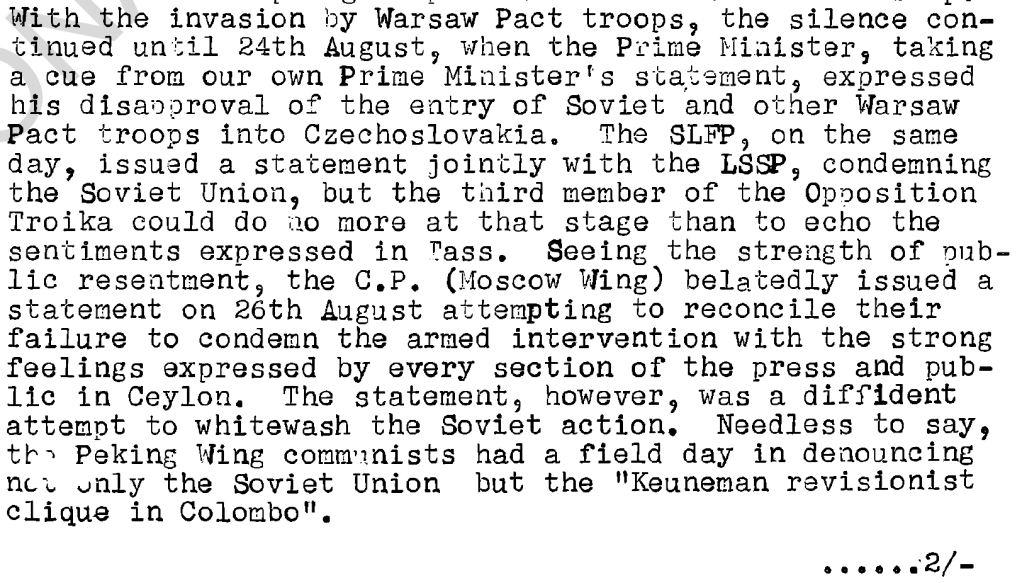
This is a summary – from the August 1968 monthly political report from the Indian High Commission in Colombo – of disagreements within the Sri Lankan left over the Soviet intervention in Czechoslovakia in 1968. I had to google “Keuneman revisionist clique” – apparently it was what the pro-Moscow, electorally-inclined faction of the Communist Party of Sri Lanka was called by its left critics. For a really deep dive, this 1974 book by an “anti-revisionist” Sri Lankan Marxist regularly uses the term, while also highlighting “the Marxist-Leninist Communist Party alone warned against placing faith in the fraud of bourgeois parliamentary democracy” and lamenting how “Khrushchov [sic] usurped power by means of a palace revolution and embarked on the treacherous course of modern revisionism, abandoning the revolutionary principles of Marxism-Leninism.”

This is an interesting new piece by Malkasian recently out in the Texas National Security Review:
“This article examines the history of war and society during the Cold War in the Middle East and parts of South Asia—two regions linked by geography, history, and culture. Few other regions have been so touched by war, or so fixed the attention of world leaders. Two themes run through the article. The first is how politics, technology, society, and culture changed the conduct of war. The second is how the conduct of war changed politics, society, and culture. The overarching argument is that a combination of pressures spread forms of war—namely, guerrilla warfare and terrorism—that put the use of force in the hands of the people. This democratization of violence complicated the consolidation of state authority and was intertwined with the return of Islam as a political force. If war after 1945 for the United States and Europe became, to quote Michael Howard, “an affair of states and no longer peoples,” then in much of the Middle East and South Asia, it became an affair of peoples as much as states.”
 Paul Staniland