Some fascinating data in a recent Livemint piece (h/t Milan Vaishnav):
“According to the political scientists, Christophe Jaffrelot and Gilles Verniers, OBCs have a share of around 20% among elected MPs in the Lok Sabha . While this figure is much more than the share of SCs, it still falls short of a proportionate share given the fact that OBCs have a population share of around 40% in India’s population. The dominance of upper castes and OBCs in Indian Union cabinets has been stark since the early days of the Indian republic, as an earlier Plain Facts column showed. The already skewed balance gets even worse when the BJP comes to power, as can be seen in the figures for 1999 and 2014.”
Sri Lankan Army KIA, 1981-1999
Below I posted about a source I’d found with micro-data on SLA combat fatalities. The OCR-ing has proven more of a challenge than I had hoped, but the information on date and place is inputted for all observations, though we still need to add many of soldiers’ names and do extensive cleaning on names of places, how to aggregate them into districts, etc. I think, combined with the qualitative research, this will also help us generate a clear order of battle for the 1980s/1990s SLA: where which units were, when, conditional on taking at least one fatality.
Preliminarily, this graph shows variation over time in SLA KIA:

The huge spikes are not surprising – the conventional phases of the LTTE-SLA war in the early and late 1990s, with dips during the IPKF and then the 1994-5 ceasefire.
Here are the places where 100 or more SLA members were killed over this period:
| Place | Freq. | Percent | Cum. |
| Vavuniya | 954 | 8.93 | 8.93 |
| Palaly | 875 | 8.19 | 17.12 |
| Paranthan | 647 | 6.06 | 23.18 |
| Kilinochchi | 555 | 5.20 | 28.38 |
| Welioya | 550 | 5.15 | 33.53 |
| Mankulam | 509 | 4.77 | 38.29 |
| Elephant Pass | 434 | 4.06 | 42.36 |
| Batticaloa | 404 | 3.78 | 46.14 |
| Mannar | 355 | 3.32 | 49.46 |
| Pooneryn | 286 | 2.68 | 52.14 |
| Jaffna | 206 | 1.93 | 54.07 |
| Mullaittivu | 199 | 1.86 | 55.93 |
| Vettalaikerni | 191 | 1.79 | 57.72 |
| Trincomalee | 185 | 1.73 | 59.45 |
| Vavuniya-Mankulam | 143 | 1.34 | 60.79 |
| Valachchenai | 120 | 1.12 | 61.91 |
| Pulmoddai | 111 | 1.04 | 62.95 |
| Kanagarayakulam | 106 | 0.99 | 63.95 |
| Vavuniya-Omanthei | 100 | 0.94 | 64.88 |
Not much surprising here, either – these are the main battle zones in and around the Tamil north and east.
So what is surprising? I’m intrigued by how *few* SLA casualties we see in the 1980s, even as the country was politically coming apart. Body counts aren’t necessarily a proxy for political disorder – throughout the contemporary and historical literature, you get a sense of a country and political system on the brink, but these are not particularly substantial death counts in comparative perspective, or compared to the size of the Sri Lankan security apparatus.
Also, 1988 and 1989 are pretty light on fatalities despite the raging JVP rebellion in the south. There are 305 KIA in those 2 years combined, with only Welioya, Mannar, Vavuniya, Trincomalee, Cheddikulum, and Matara having 8 or more KIA combined during those two years. I’m going to be doing more on the spatial breakdown of the 1981-87 period with an eye on the LTTE’s rise and then 1987-89 period with a JVP focus.
So either the Army wasn’t that involved in anti-JVP operations compared to the police (data on which I continue to be in search of!) and pro-state paramilitaries, or they were involved but were not particularly vulnerable to JVP operations. I continue to wonder where the claims about total death counts (~40,000) in the 1987-1990 period actually come from, though it’s clear that civilians overwhelmingly bore the brunt of the violence and their experiences are unlikely to recovered from history.
My thoughts on the Indian “surgical strike”
Varshney on Pakistan
In today’s Indian Express, featuring the research of Christine Fair, Yelena Biberman-Ocakli, and me.
Summaries of my basic framework for thinking about these questions can be found here (2015 JCR article) and here (2016 working paper).
Research on Indo-Pak deterrence
Political scientists and analysts have been churning out work on the India-Pakistan nuclear and conventional balance and its political implications, particularly since both countries tested nuclear weapons in 1998. Below are a few prominent books and articles worth looking at for those interested in how escalation, deterrence, and the nitty-gritty of war-fighting might play out. I don’t work on this topic, so I defer to these colleagues for their expertise (though there is often a range of differing opinion!).
This is just a limited sample of a much broader and richer literature, but a good starting point for people trying to figure out what is make of the current situation:
Vipin Narang, Nuclear Strategy in the Modern Age; article version here. Also a Washington Quarterly piece on India’s nuclear posture.
Sumit Ganguly and Devin Hagerty, Fearful Symmetry.
Paul Kapur, Dangerous Deterrent. See Ganguly and Kapur in this issue of International Security summarizing key arguments.
Walter Ladwig, “A Cold Start for Hot Wars?”
Shashank Joshi, “India’s Military Instrument: A Doctrine Stillborn.”
Clary, Kampani, and Sankaran, “Correspondence: Battling Over Pakistan’s Battlefield Nuclear Weapons.”
Scott Sagan, ed., Inside Nuclear South Asia.
Krepon and Thompson, eds., Deterrence Stability and Escalation Control in South Asia.
Tellis, Fair, and Medby, Limited Conflict Under the Nuclear Umbrella.
Ashley Tellis, India’s Emerging Nuclear Posture.
George Perkovich, India’s Nuclear Bomb.
Chari, Cheema, and Cohen, Four Crises and a Peace Process.
Christine Fair, Fighting to the End.
Peter Lavoy, ed., Asymmetric Warfare in South Asia.
Where Balochistan Police got killed
I noted in an earlier post that we’d been working through some data on Balochistan Police killed in action. There are a million caveats with these data, but they provide at least a rough handle on some aspects of the conflict.
Today I want to show some preliminary evidence on the spatial distribution of violence. There is a problematic curiosity here, however: two “districts” are actually units of the police: Balochistan Constabulary (BC) and Anti-Terrorism Force (ATF).
Here are the top 15 areas/units of casualties (covering 93% of the fatalities):
| District | Freq. | Percent | Cum. |
| Quetta | 265 | 39.14 | 39.14 |
| B.C | 96 | 14.18 | 53.32 |
| Naseerabad | 51 | 7.53 | 60.86 |
| Jaffarabad | 47 | 6.94 | 67.80 |
| Pishin | 27 | 3.99 | 71.79 |
| Lasbela | 21 | 3.10 | 74.89 |
| Khuzdar | 20 | 2.95 | 77.84 |
| ATF | 19 | 2.81 | 80.65 |
| Mastung | 14 | 2.07 | 82.72 |
| Kech | 13 | 1.92 | 84.64 |
| Sibi | 13 | 1.92 | 86.56 |
| Panjgoor | 12 | 1.77 | 88.33 |
| Kachhi | 11 | 1.62 | 89.96 |
| Kalat | 11 | 1.62 | 91.58 |
| Noshki | 10 | 1.48 | 93.06 |
We were able to do some digging on the B.C. fatalities. Of the 96 BC KIA, we found some evidence of where members were killed in 28 cases. All 28 were in the vicinity of Quetta, which could be 1) due to reporting being more likely around Quetta, or 2) the BC being heavily used in Quetta.
We’ll be doing more work, but it’s notable how much of the police targeting seems to have been in and around Quetta. The Army and Frontier Corps may be out in the rural areas disproportionately absorbing casualties that aren’t systematically publicized. There are also the Balochistan Levies’ “B areas”; I have been able to find basically nothing from this force. But even given all of this, the police data are a reminder that Balochistan is not simply a conflict of distant, rural, mountainous guerrilla warfare.
Please don’t use Wikipedia (alone)
Just an example: the Wikipedia entry on the Khilafat movement argues of its collapse in 1922 that “In wake of the ignominious statute of the Nehru Report, the Ali brothers began distancing themselves from Gandhi and the Congress.”
Yet, the entry on the Nehru Report (linked to in the very same Khilafat entry) correctly notes that the Report actually happened in 1928. Unless the Ali brothers had remarkable foresight, the original claim seems rather problematic.
Wikipedia is really useful in many ways. It is also wildly unreliable, something that too many students don’t fully seem to grasp. Don’t make that mistake.
Read Ahsan Butt on Uri
Link here. That is all.
You can’t beat something with nothing
That’s the basic message of Pratap Bhanu Mehta’s most recent Indian Express column, on the failures of the opposition to construct a plausible alternative to Narendra Modi:
“But the sheer self-destructive pettiness and parochialism of the other parties is making it likely that the BJP’s failings will not be challenged by a credible Opposition, but by an outbreak of infantilism, where each alternative leader seems to get smaller by the day.. . .
The danger is that new forms of social conflict may no longer be channelled through political parties. Besides the total loss of control in Kashmir, we have seen violent agitations in the economic powerhouses of Gujarat, Karnataka and Haryana this year. Kerala is emerging as a new hotbed of violence, its model now under serious social strain. Maharashtra is on the verge of major caste conflict, and criminality and communalism still define UP’s identity. India will need deeper political resources for social mediation. All it might get is an Opposition that seems not to want to rise to challenges; they are all making Modi look larger than he is.”
Serendipitous research gold
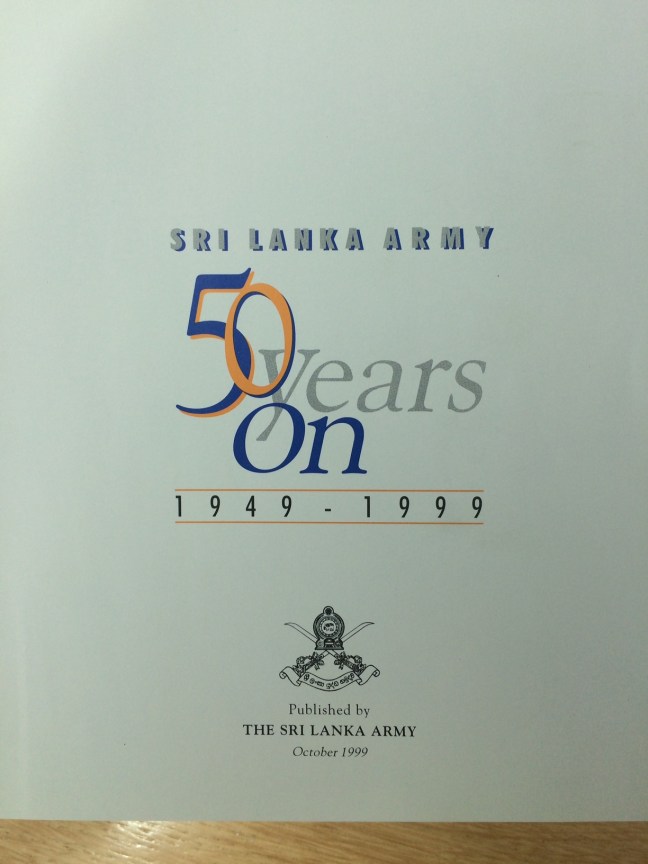
My Sri Lanka project sporadically moves along in parallel to my more regular preoccupation with Chapter 4 of my book. I made a very lucky find recently – while wandering the footnotes of a pop military history of the Eelam wars, I found a reference to a book called Sri Lanka Army: 50 Years On (1999), which looked to be an official history of the Army. But it turned out that only three libraries in WorldCat own a copy (the Marines, the Army, and the Library of Congress).
I got a copy ILL-ed. . . .and lo and behold, in addition to a history of the army and its activities, the last ~200-odd pages are a Roll of Honour that lists the name, rank, unit, date, and place of death for over 10,000 SLA combat fatalities between 1981 and 1999. I told my RA’s to scan the whole book before we had to return it. Being less than thrilled with scanning 1,000 pages, they went looking for a copy to buy. Even though Amazon showed no available results when searching by name, for some reason one came up when they searched by ISBN. A random used bookstore had a copy which we got for $7 (then refunded when delivery got messed up).
Initial scanning and OCR suggests we’ll be able to turn the combat fatality data into a dataset fairly easily, which will allow a new mapping of SLA deaths by date and place during the LTTE and JVP revolts of the 1980s (it’s less interesting post-1990, when it’s a series of conventional clashes with the Tigers). There’s also a lot of useful nitty-gritty security studies stuff on organizational structures and army combat operations.
Of course, the Sri Lankan Police have not responded to my ~12 emails to them about police data, so you can’t always get what you want, but some footnote digging and luck can open unexpected new doors.
 Paul Staniland