I know it’s a cliche, but I actually am thrilled that Aidan Milliff and I have a new book out today – and it’s open access online for the next couple of weeks.
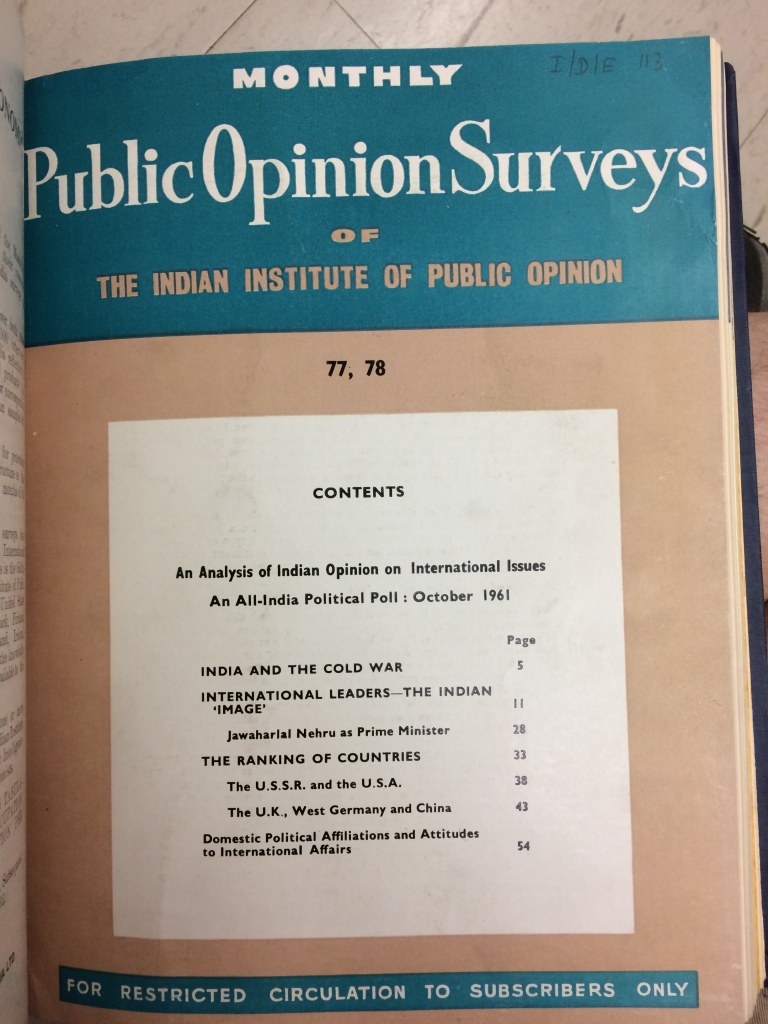
The photo below is of the 1961 International Images survey conducted by the Indian Institute for Public Opinion (IIOPO) that I’d serendipitously found in the The University of Chicago Library in the summer of 2017. These were regular surveys of the urban Indian public’s views of foreign countries and international topics. I knew others had referenced these surveys, but hadn’t found systematic use of them.
Over the ensuring 9 years, Aidan, excellent UChicago RA’s, and I tracked down remaining issues, compiled an index of questions, found raw data stored at the Roper Center, and compared these pre-2000 data with post-2000 surveys of Indians’ views from other pollsters, trying to identify continuities and differences over time.
The initial goal was to build a comprehensive view of Indians’ attitudes toward foreign policy. That may need to wait, given the enormous quantity of material! We ended up focusing on Indian views of China, the US, and Russia/USSR since the 1950s, which forms the core of our new monograph. We explore trajectories over time in attitudes toward the major powers, who has constituted India’s “foreign policy public,” individual-level sources of variation in these views, drivers of change, new and unanswered questions, and implications for both research and policy. There are cool maps, and graphs, and interesting historical vignettes.
Moreover, we indexed numerous other foreign policy questions that exist in these publications (N=1,500). This index will be available online for those who want to know where to consult the IIOPO publications.
I’m grateful to Aidan for being a spectacular coauthor, numerous great RA’s, thoughtful and demanding peer reviewers, and Kai He and the editorial team of the fast-growing new Cambridge University Press Elements Series in Indo-Pacific Security.
What did we end up finding? You should read the whole thing to find out! But I’ll be rolling out a few takeaways in the coming days.
The one I want to begin with: the Indian public has not seen major power competition through a zero-sum lens. Rather than a hard US-Soviet or US-Russia trade-off in public attitudes, we see extended periods during the Cold War and afterward (including since 2022) in which public sentiment was broadly positive toward both countries simultaneously. There is a broad, public basis for “multi-alignment.” US policy during the Cold War and at times since (i.e. after the Russian invasion of Ukraine) has pushed India to make choices, but this is not how the public sees the world. There are important implications for Washington in a world of diffusing power and ongoing geopolitical rivalry.