Cup of Tea. May 24, 2026.

The question of whether mass publics pay attention to foreign affairs is a fundamental one. Some have expressed skepticism of whether the public knows or cares enough to form opinions, suggesting that, to the extent there is a coherent attitude it is driven by “elite cues” – ordinary people drawing their opinions from leaders or parties they trust. Others have pushed back, suggesting that the public can somewhat independently form attitudes that reflect objective conditions, rather than either being incoherent or simple reflections of elite cues.
This is a particularly interesting question in the case of India. On the one hand, we could imagine that in an electoral democracy that operates in a complex, often difficult international environment, the public should have strong incentives to pay attention. The stakes are high, and there are instances in which politicians faced serious criticism over foreign policy (Nehru after the 1962 war, for instance). On the other hand, Indian domestic politics are themselves wildly complex, usually have little to do with geopolitics (with occasional exceptions), and are focused on pressing issues of governance, identity, development, and coalitional wrangling. Indeed, most regular surveys of Indians going back decades (such as by CSDS) spend very little time asking about foreign policy.
In our new book (Open Access at present), Aidan Milliff and I examine this question in the context of Indians’ views of the US, China, and Russia/USSR (and Chapter 1 provides an overview of the literature summarized above).
Our findings are nuanced.
It is clearly the case that only a subset of the Indian population regularly expresses opinions on foreign affairs in surveys – as in other societies, the “foreign policy public” is non-representative and biased by education and socioeconomic status. The public that is responding to these questions is not the same as the actual public, which is less informed and/or less interested than the foreign policy public. This makes it unlikely that voters or elections are consistently driven by foreign policy, especially since in India there is evidence that lower-SES citizens are not less likely to vote than (the far less numerous) higher-SES citizens (a contrast to the US, where the less-educated turn out less). To be clear, this is not a criticism: citizens have remarkably strong reasons to focus more on feeding their families or pursuing representation in the state than on studying the finer points of Russian foreign policy or keeping track of Paraguayan election results.
That said, among the foreign policy public, we find that attitudes are quite coherent, responsive to events, and broadly consistent with Bruce Jentleson’s classic framing of a “pretty prudent public.” Moreover, we find non-response rates dropped on some very highly salient/public issues, so even people who are not normally tuned in to international affairs may start paying attention during crises. This opens potential space for bottom-up constraints or pressures on policymakers under narrow-but-important conditions.
We also found evidence of public knowledge about the United States that puts to shame Americans’ knowledge of India – for instance, in 1968, 78% of respondents (in a very limited urban sample, to be clear) knew about LBJ’s decision not to stand for reelection, and in 1960, 80% of respondents knew the political party of John F. Kennedy. By contrast, in 2023, 40% of Americans had not heard of Narendra Modi.
We cannot make confident claims about elite cueing, but do find several cases in which public opinion trended in a very different direction than government discourse – for instance, views toward China in the 2010s start dropping well before the Indian government’s public turn toward a more assertive stance. Elite cues are obviously important, but also not determinative. Indian political leaders certainly have a lot of “slack” between their foreign policies and public opinion, but it is not infinite, nor is it consistent across issues.
I know it’s a cliche, but I actually am thrilled that Aidan Milliff and I have a new book out today – and it’s open access online for the next couple of weeks.
The photo below is of the 1961 International Images survey conducted by the Indian Institute for Public Opinion (IIOPO) that I’d serendipitously found in the The University of Chicago Library in the summer of 2017. These were regular surveys of the urban Indian public’s views of foreign countries and international topics. I knew others had referenced these surveys, but hadn’t found systematic use of them.
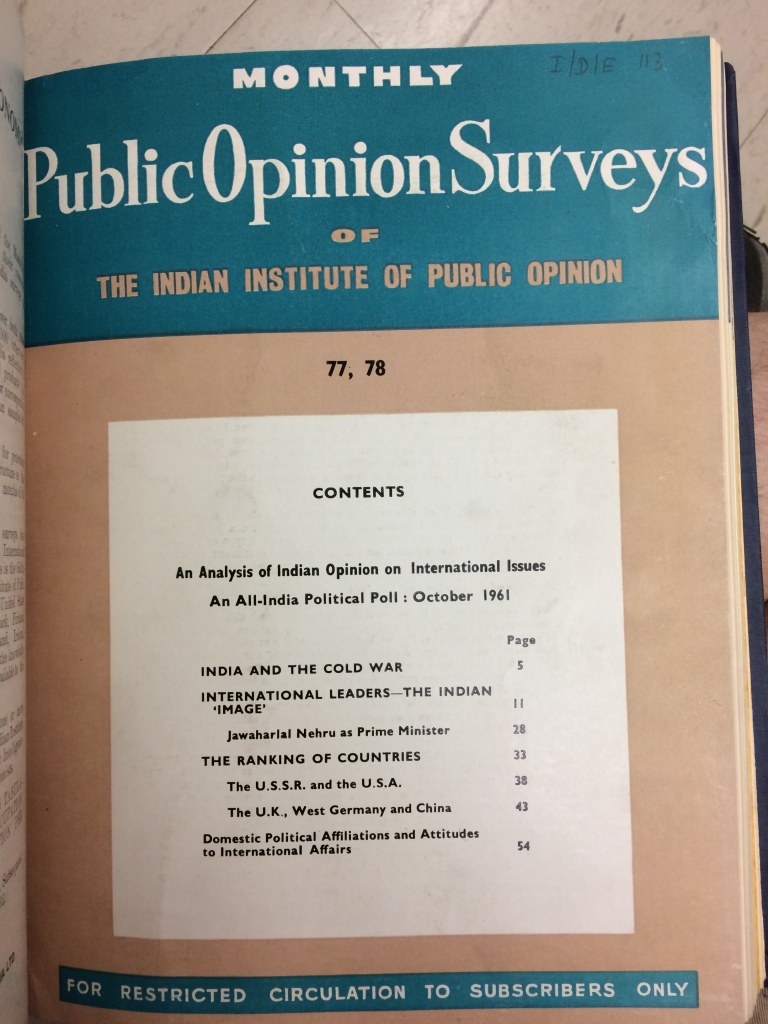
Over the ensuring 9 years, Aidan, excellent UChicago RA’s, and I tracked down remaining issues, compiled an index of questions, found raw data stored at the Roper Center, and compared these pre-2000 data with post-2000 surveys of Indians’ views from other pollsters, trying to identify continuities and differences over time.
The initial goal was to build a comprehensive view of Indians’ attitudes toward foreign policy. That may need to wait, given the enormous quantity of material! We ended up focusing on Indian views of China, the US, and Russia/USSR since the 1950s, which forms the core of our new monograph. We explore trajectories over time in attitudes toward the major powers, who has constituted India’s “foreign policy public,” individual-level sources of variation in these views, drivers of change, new and unanswered questions, and implications for both research and policy. There are cool maps, and graphs, and interesting historical vignettes.
Moreover, we indexed numerous other foreign policy questions that exist in these publications (N=1,500). This index will be available online for those who want to know where to consult the IIOPO publications.
I’m grateful to Aidan for being a spectacular coauthor, numerous great RA’s, thoughtful and demanding peer reviewers, and Kai He and the editorial team of the fast-growing new Cambridge University Press Elements Series in Indo-Pacific Security.
What did we end up finding? You should read the whole thing to find out! But I’ll be rolling out a few takeaways in the coming days.
The one I want to begin with: the Indian public has not seen major power competition through a zero-sum lens. Rather than a hard US-Soviet or US-Russia trade-off in public attitudes, we see extended periods during the Cold War and afterward (including since 2022) in which public sentiment was broadly positive toward both countries simultaneously. There is a broad, public basis for “multi-alignment.” US policy during the Cold War and at times since (i.e. after the Russian invasion of Ukraine) has pushed India to make choices, but this is not how the public sees the world. There are important implications for Washington in a world of diffusing power and ongoing geopolitical rivalry.