The MHA and the Emergency

From the Ministry of Home Affairs Annual Report, 1975-76:
“it is only when such activities had crossed all permissible limits that the Government was constrained to declare Emergency on June 2, 1975, as no Government worth the name could allow the country’s security, stability and economy to be imperiled. The nation’s interests demanded firm and decisive action. . . . diffidence and apathy have given place to confidence that we can face our problems successfully if we are disciplined and united” (iii)

BK Nehru is a charmer

BK Nehru held various positions in Indian government, including governor of numerous states and ambassador to the US. I’ve been going back over his notes from the amusingly titled Nice Guys Finish Second on his time in Nagaland. Some choice quotes:

“What I was faced with here was incredibly tiny groups of separate identities with problems so small that I could not grasp why they should be bothered about” (p. 477)

“the demand for Naga independence was nonsense” (p. 503)

“they [Naga rebels] should never forget that they were nothing more than a bunch of ignorant brigands living on money extorted from their own people and the charity of foreign countries” (p. 511)

“the ‘problem’ was in reality the shock inflicted on the Naga social system by the sudden removal of its protected isolation from the modern world which its status as an excluded area had provided it. . . the solution lay in the passage of time” (p. 518)

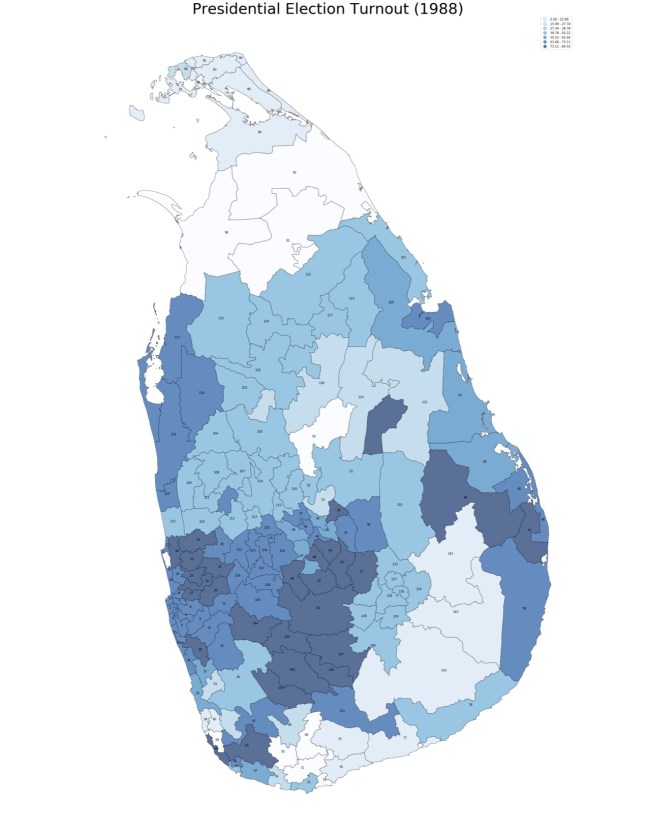
Sri Lanka electoral turnout, 1988

My excellent researchers Wenyan Deng, Winston Berg, and Cathryn Grothe have done great work tracking down disaggregated electoral turnout/vote shares, Sri Lankan Police and Army fatalities, and a map of polling divisions in Sri Lanka.

As a first-cut of what will come, here’s a map by polling division (the smallest unit we have data on) of electoral turnout in the 1988 election; the darker the color, the higher the turnout. What I’m interested in: those deep South and some Central divisions with very low turnout. Why? In our SLA fatalities data, they also show very very few SLA deaths over the whole course of 1988 (we’ll see what the Police data show – may be different). By contrast, the north continues to be a place where the SLA (and, vastly more so, the IPKF) are mixed up with the LTTE, so turnout and fatalities align more closely.

The JVP in 1988 was not yet targeting the Army, so looking at security force fatalities (with Police caveat!) proves to be a highly unreliable guide to areas of JVP influence in this period. But since the JVP wanted a boycott, turnout becomes a more useful proxy. The right indicator to use for measuring armed group presence/influence/control is likely to be highly contextual – sometimes it will be violent events, but sometimes it won’t.

1988turnoutJPG


In defense of military history

This is a valuable piece by Robert Farley. There are many valuable and important ways to study history. But it’s baffling to me that anyone would think that questions like “Why was the Wehrmacht so good at fighting wars?” or “How well did the North Vietnamese Army evade American airpower?” or “What did conscription during Vietnam do to the fighting power of the US Army?” or “What let Japan defeat Russia in 1905?” or numerous other questions are historically trivial or not worth studying. As a historically-minded political scientist, I rely heavily on skilled historians to grapple with questions like these. It’s a shame to see “open hostility” to this kind of research.

Useful articles on China-India-Bhutan stand-off

I’ve found it complicated and often hard to follow, but these recent pieces have been very helpful:

Ankit Panda, “The Political Geography of the India-China Crisis at Doklam,” The Diplomat

Jeff Smith, “High Noon in the Himalayas,” War on the Rocks.

Iskander Rehman, “Hard Men in a Hard Environment,” War on the Rocks [background information on the military balance and strategies].

Taylor Fravel interview on Rediff.com.

Sushant Singh, “Motorable track at the centre of tug-of-war with Beijing,” Indian Express.

Interview with Shivshankar Menon in the Hindu.

Rohan Mukherjee, “Sikkim Stand-off: What Explains China’s coercive diplomacy?” Business Standard.

“Sikkim Impasse: What is the India-China-Bhutan Border Stand-Off,” Indian Express.

Manoj Joshi, “On India-China Himalayan face-off, China may just have a case,” Indian Express.


3 review essays including my book

There are three recent/forthcoming review essays that include my book as part of broader discussions about the state of research on political violence:

  1. Sarah Parkinson and Sherri Zaks, “Militant and Rebel Organization(s),” Comparative Politics, forthcoming 2018.
  2. Christopher Day, “Review Article: Civil War and Rebellion,” Studies in Conflict and Terrorism, 2017.
  3. Todd Lehmann, “The dynamics of radicalization: a relational and comparative perspective,” Democratization, 2017

Political violence in democracies (& America)

A week or two ago I got asked by Vox to respond to a couple questions about political violence in democracies, and in America in particular. My answers didn’t make the cut for the article (in favor of shorter and better answers by more famous people!) so I thought I’d just reproduce them below. But two additions. First, in the American case, the violence accompanying the overthrow of Reconstruction seems badly under-studied by political scientists interested in political violence, militia and paramilitary mobilization, sub-national authoritarianism and democratic collapse, and permeable boundaries between “normal” and “abnormal” politics. Second, a point that Christian Davenport has rightly pushed me on, even in “peaceful democratic societies” there is often extensive *state* violence that can be analytically hidden by reframing it as either apolitical (i.e., policing in the US, which is too often portrayed as a technocratic matter of law and order/bureaucratic processes) or as distinct from non-state violence. In the US case, the Department of Justice and local police departments have been deeply political actors, seeking to build and protect particular national and local visions of the state, nation, and contours of democracy.  Political scientists are now starting to study it (for instance, Soss and Weaver, Mummolo), which is awesome. Hopefully we will see a re-balancing toward these kinds of fundamental questions of order, state violence, and social control in the US as part of a process of deprovincializing the study of America.

Paul talks to Vox:

“Question 1) Why do peaceful democratic societies tend to descend into violence?
Paul: It’s extremely rare for fully consolidated, Western democracies to descend into large-scale political violence. However, violence in democracies remains quite common. Roughly speaking, we can see four patterns of political violence in democracies, in order from most to least severe. First, the most severe political violence in democracies occurs when central governments themselves split apart into warring elite factions, as in the American, Lebanese, or Spanish Civil Wars. This can lead to state failure and/or conventional civil war. Second, very commonly, we can see robust insurgencies in democracies. These are most likely when central governments are unable to extend total control over violence to geographic and social peripheries, and face either excluded ethnic groups or revolutionary movements able to mobilize poor, lower-class populations against the metropole. Colombia, Sri Lanka, and the Philippines are good examples, with electoral politics coexisting with pitched insurgent warfare.

Third, electoral violence is quite common in democracies, ranging from riots and pogroms to intense state repression of opposition parties and dissidents to the rise of armed political parties. This is most likely in weakly-institutionalized environments when contenders fear that if they do not win/hold onto power, they will be thoroughly excluded from political power in the future. It can also occur when the rule of law has been politicized to an extent that law and order becomes subservient to the needs of strategic politicians trying to win elections by polarizing the electorate or targeting the supporters of rivals. The politicization of policing can be particularly dangerous here, opening space for specialists in violence, thugs, and the armed militias of political parties to use violence without facing sanction or repression. Kenya, Weimar Germany, and India are cases in which electoral violence has sometimes been very intense. The same was true in some American cities in the 19th century, often linked to ethnicized patronage politics, and in the deep South as part of the maintenance of white supremacy.

Finally, there can be violence in relatively rich and consolidated democracies. There are radical revolutionary movements, generally separatist, leftist, or Islamist, that use violence to try overthrow the political system; these anti-systemic challenges see “mainstream” politics as a hopeless pathway for affecting real change. Northern Ireland, Basque country, Islamist militants, and leftist terrorists in the 1960s and 1970s show how diverse these anti-systemic militants can be. A more complex type of violence can come from the right, with groups like the KKK and radical militia movement in the US, that claim to be restoring/protecting the “true” nation/Constitution. They articulate their violence in terms of maintaining or restoring an idyllic past, not replacing it with a fundamentally new order. The past they claim to uphold was generally highly repressive/exclusionary, and these groups’ violence reflects their goal of a return to their own dominance. While the central state is comparatively powerful in these rich-democracy contexts, arms remain available to some extent, governments may misjudge the extent of the threat they face or only be able to contain rather than eliminate it, and political polarization creates segments of society that view violence, or its threat, as the only way to escape an otherwise intolerable status quo.

Question 2) Is America regressing back into a more politically violent society (as we were in, say, the 60s)?
Paul: We are certainly not close to the level of the 1960s, when a variety of non-state and government forces used substantial violence. But there is potential for real danger. Government violence, by local police departments, has become a much more salient focus of discontent, and requires urgent attention. On the non-state side of things, extremist groups on the right became far more vocal during the Obama years, and many viewed Donald Trump quite favorably. This movement will continue to draw on anti-Muslim, anti-Semitic, and anti-immigrant sentiment to justify its existence. The armed left appears to be far smaller, but clashes in cities and campuses since Trump’s election suggest the possibility of escalation. America has a long history of political violence that is fundamental to its political development, from the Civil War to labor strife to lynchings to vigilantism to state repression to the cleansing of Native Americans. There is no reason to expect that it will go away, especially in these deeply polarized and uncertain times, but the current situation does not resemble the most dramatic instances of violence in the American past.”

Researching Armed Politics

Back in the fall of 2004 I found myself staring at the Wikipedia page for Mali, trying to code something about the nature of Tuareg rebels. This was for a stats class where I needed to supplement Nick Sambanis’ civil war dataset (I think I was trying to explain which civil wars end up conventional and which end up insurgencies; data later lost to hard drive crash pre-Dropbox). I found the whole affair fairly absurd, since I knew nothing about Mali, or anywhere else. Which is when I decided to focus in on more case-specific analyses, and eventually ended up specializing in South Asia.

In the last few years I’ve come back to the big quantitative, cross-national datasets. It began after I published a conceptual piece in 2012 on “wartime political orders,” laying the early basis for my current book project. I had grand ambitions of pulling some of the existing data on civil wars, armed groups, peace deals, ceasefires, and the like off the shelf (Walter, Fortna, UCDP, PRIO, Sambanis, Fearon and Laitin, etc.) to code these wartime political orders, and complement them with my own case studies – and voila, book!

But it quickly turned out that the landscape of political violence I was familiar with in South Asia was only partially, at best, represented in the most-cited and important datasets – some groups and conflicts didn’t exist in the datasets, some were coded radically differently across datasets (depending on who you believe among two of the most prominent early 2000s datasets, India’s Northeast got itself a civil war either in 1952 or 1990), others popped in and out for only specific years of their much longer existences, most of the ceasefires and some of the peace deals I was seeing in the cases were missing, etc.

Much of this was because I was interested in a broader phenomenon – the full range of armed group-government interactions, across levels of violence and state-group cooperation. So it was unfair to blame the datasets for that: they were just measuring something different. But some of the issues were because there were no or very thin/inappropriate sources, which led to lots of missingness even where there should have been data. It became clear that if I wanted to actually measure this stuff, I’d have to do it as a complement to existing data, rather than using them directly.

The toughest thing  was nailing down what exactly the dependent variable was I wanted to measure – I became dissatisfied with wartime political orders (what about non-wartime contexts?; the active/passive/no cooperation thing wasn’t ideal; the territorial segmentation wasn’t all that theoretically interesting in retrospect) – but didn’t know what to put in its place precisely, much less how to measure it.

This triggered a long process of conceptualizing, operationalizing, and, finally, now, building new data to represent these state-group armed orders, as part of a broader approach I call armed politics. A 2015 JCR piece, ostensibly about militias but really about all kinds of groups, started to think through these outcomes, but didn’t figure out how to measure anything and remained conceptually fuzzy in some important ways (was I looking at government strategy? Dyadic orders?). Fieldwork in India, Thailand, and Burma/Myanmar (plus some awesome libraries in Singapore), reading books, looking over datasets, and accumulating government reports and press accounts is how I had to figure this out.

The first piece to offer an empirical agenda for systematically(-ish?) measuring these orders just came out in the Journal of Peace Research. I’ve disaggregated the JPR version of coding slightly (as I note in a footnote, military hostilities can be broken further into containment and total war orders), but the basic approach is what a research team has been working on for the last year in my Armed Orders in South Asia (AOSA) project. They’ve been writing up case studies on each state-group dyad based on a variety of sources, many of them local or specialist. Some of the key characteristics we get at in the case studies are then quantified (in a way that allows many of the state-group dyads to be directly linked to Uppsala conflict dyads, though many of my dyads don’t show up in UCDP). Eventually both the cases and dataset will get publicly posted with lots of footnotes and bibliographies.

So what have I learned from all of this?

  1. Taking a look under the hood of prominent datasets, and especially looking at their sourcing documents (if they exist), is incredibly valuable. There can be some interesting stuff under there. We face powerful incentives to grab data and run with them, while sidestepping questions of quality and sourcing. That’s fine and tons of great papers get into top journals doing so, but there are some issues that are rarely discussed. Open up the sourcing and take a hard look at the cases you know well, and see what you think – and what its implications are for description and inference.
  2. Most of the cross-national and cross-dyad data are based on case studies that form the basis for quantitative data. Good qualitative evidence, in this context, is necessary for good quantitative evidence; if the qualitative data is bad, there’s no reason to expect good quantitative data. This is especially problematic if we have reason to think the quality of the qualitative sources is systematically biased, across regions, time, types of conflicts, etc (I have a sneaking suspicion that Manipur, Shan State, and Balochistan get way less international attention and scholarly coverage than, say, Northern Ireland or Iraq). All datasets, including mine, will miss or get things wrong; the question is how much bias there is in these misfires, and what you can live with for the questions you’re asking.
  3. There are hard trade-offs involved, though – doing really thorough deep dives into local sources, the secondary literature, etc. is only possible for a subset of cases, rather than being able to cover everything all the time. Choices have to be made, none will be perfect, and there are a variety of legitimate bets to make on what will be most fruitful.
  4. Going from concept to theory to data takes a very long time. Trying to figure out a new dependent variable at any of these levels is tricky. I don’t have the methodological firepower of many of my (brilliant) peers, so I make my living, in part, by coming up with interesting new ideas and concepts. At various points this ended up taking me down dead ends, aimless wanderings, and data approaches that unambiguously failed. And once I ended up getting grant money to do the broader armed politics data project and figured out the timeline involved, I realized the book would take a lot longer than I expected. The best-laid plans often fall quickly by the wayside; that’s just part of the business.