Where Balochistan Police got killed

I noted in an earlier post that we’d been working through some data on Balochistan Police killed in action. There are a million caveats with these data, but they provide at least a rough handle on some aspects of the conflict.

Today I want to show some preliminary evidence on the spatial distribution of violence. There is a problematic curiosity here, however: two “districts” are actually units of the police: Balochistan Constabulary (BC) and Anti-Terrorism Force (ATF).

Here are the top 15 areas/units of casualties (covering 93% of the fatalities):

District Freq. Percent Cum.
Quetta 265 39.14 39.14
B.C 96 14.18 53.32
Naseerabad 51 7.53 60.86
Jaffarabad 47 6.94 67.80
Pishin 27 3.99 71.79
Lasbela 21 3.10 74.89
Khuzdar 20 2.95 77.84
ATF 19 2.81 80.65
Mastung 14 2.07 82.72
Kech 13 1.92 84.64
Sibi 13 1.92 86.56
Panjgoor 12 1.77 88.33
Kachhi 11 1.62 89.96
Kalat 11 1.62 91.58
Noshki 10 1.48 93.06

We were able to do some digging on the B.C. fatalities. Of the 96 BC KIA, we found some evidence of where members were killed in 28 cases. All 28 were in the vicinity of Quetta, which could be 1) due to reporting being more likely around Quetta, or 2) the BC being heavily used in Quetta.

We’ll be doing more work, but it’s notable how much of the police targeting seems to have been in and around Quetta. The Army and Frontier Corps may be out in the rural areas disproportionately absorbing casualties that aren’t systematically publicized. There are also the Balochistan Levies’ “B areas”; I have been able to find basically nothing from this force. But even given all of this, the police data are a reminder that Balochistan is not simply a conflict of distant, rural, mountainous guerrilla warfare.


Please don’t use Wikipedia (alone)

Just an example: the Wikipedia entry on the Khilafat movement argues of its collapse in 1922 that “In wake of the ignominious statute of the Nehru Report, the Ali brothers began distancing themselves from Gandhi and the Congress.”

Yet, the entry on the Nehru Report (linked to in the very same Khilafat entry) correctly notes that the Report actually happened in 1928. Unless the Ali brothers had remarkable foresight, the original claim seems rather problematic.

Wikipedia is really useful in many ways. It is also wildly unreliable, something that too many students don’t fully seem to grasp. Don’t make that mistake.

You can’t beat something with nothing

That’s the basic message of Pratap Bhanu Mehta’s most recent Indian Express column, on the failures of the opposition to construct a plausible alternative to Narendra Modi:

“But the sheer self-destructive pettiness and parochialism of the other parties is making it likely that the BJP’s failings will not be challenged by a credible Opposition, but by an outbreak of infantilism, where each alternative leader seems to get smaller by the day.. . .

The danger is that new forms of social conflict may no longer be channelled through political parties. Besides the total loss of control in Kashmir, we have seen violent agitations in the economic powerhouses of Gujarat, Karnataka and Haryana this year. Kerala is emerging as a new hotbed of violence, its model now under serious social strain. Maharashtra is on the verge of major caste conflict, and criminality and communalism still define UP’s identity. India will need deeper political resources for social mediation. All it might get is an Opposition that seems not to want to rise to challenges; they are all making Modi look larger than he is.”

Serendipitous research gold

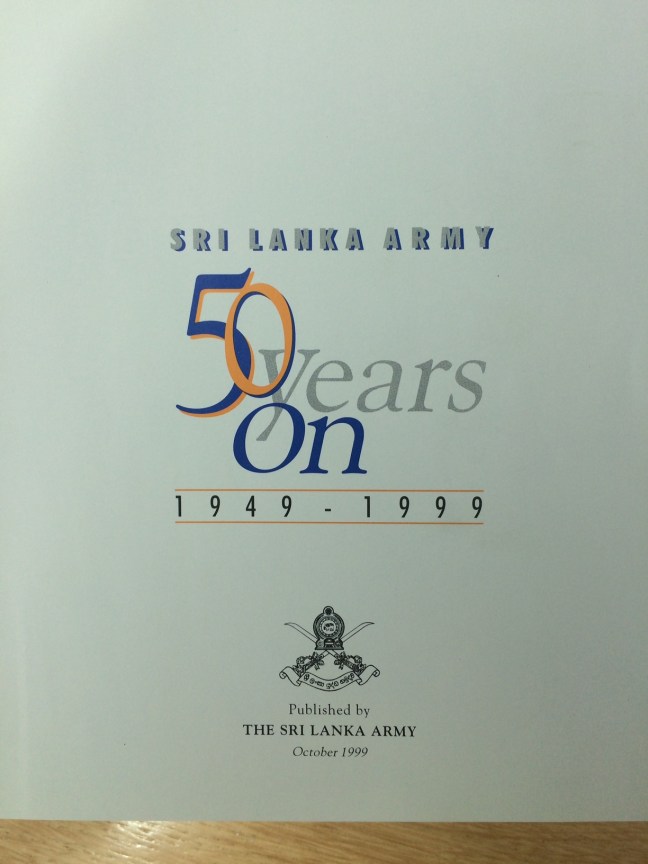
My Sri Lanka project sporadically moves along in parallel to my more regular preoccupation with Chapter 4 of my book. I made a very lucky find recently – while wandering the footnotes of a pop military history of the Eelam wars, I found a reference to a book called Sri Lanka Army: 50 Years On (1999), which looked to be an official history of the Army. But it turned out that only three libraries in WorldCat own a copy (the Marines, the Army, and the Library of Congress).

I got a copy ILL-ed. . . .and lo and behold, in addition to a history of the army and its activities, the last ~200-odd pages are a Roll of Honour that lists the name, rank, unit, date, and place of death for over 10,000 SLA combat fatalities between 1981 and 1999. I told my RA’s to scan the whole book before we had to return it. Being less than thrilled with scanning 1,000 pages, they went looking for a copy to buy. Even though Amazon showed no available results when searching by name, for some reason one came up when they searched by ISBN. A random used bookstore had a copy which we got for $7 (then refunded when delivery got messed up).

Initial scanning and OCR suggests we’ll be able to turn the combat fatality data into a dataset fairly easily, which will allow a new mapping of SLA deaths by date and place during the LTTE and JVP revolts of the 1980s (it’s less interesting post-1990, when it’s a series of conventional clashes with the Tigers). There’s also a lot of useful nitty-gritty security studies stuff on organizational structures and army combat operations.

Of course, the Sri Lankan Police have not responded to my ~12 emails to them about police data, so you can’t always get what you want, but some footnote digging and luck can open unexpected new doors.

fullsizerender


SAMP Sources

The South Asia Materials Project (SAMP) at the Center for Research Libraries is an amazing collection of political sources. It’s particularly useful for the colonial period, but also has some interesting stuff on the post-independence period (especially in India).

For grad students looking for things to study, I suggest wandering the microfilms of these collections (hyperlinks below to PDF guides):

Confidential Publications and Home Political Files – lots from the Indian press as monitored by the British.

Documentation of Emergency Period in India (June 1975 – March 1977) – various correspondences and documents, including among underground activists, political prisoners, from the wildly under-studied Emergency.

Indian Proscribed Tracts, 1907-1947 (note: there is a 1954 Naga tract in here, so 1947 seems like a fuzzy end-date)

And, above all, the Norman Gerald Barrier collection of South Asian political tracts. This collection is most interesting to me because 1) it is mostly post-1947 and 2) it sheds light on the full spectrum of parties, movements, and intellectual currents in post-colonial India, moving beyond the historian’s focus on the colonial era and the political scientist’s obsession with the Congress and mainstream electoral politics. It has documents by and about socialists, communists, the Indian right (in both its Hindutva and Swatantra strands), separatists, activists, and provincial politicians, plus of course the Congress and its rivals.

Microfilm is terribly old-fashioned, but there is amazing stuff in the SAMP, and I hope it gets more use from scholars of contemporary South Asia.


PDP follow-up

Down below I offered my read on the PDP’s failure in Kashmir. Muzamil Jaleel, whose work in the Indian Express I always read, has a long, detailed piece on how top PDP leaders are viewing their situation.

Some snippets:

“there is confusion in the PDP ranks and a growing feeling that the party, already questioned for its alliance with the BJP, may be compromising on its core politics.

Its hope is that the shortage of food and fuel, and closure of schools and businesses would ultimately set off fatigue and force people to return to ‘normalcy’.

“We have abandoned our core political stance on the Kashmir issue and there are no takers here for the politics of development,” he said. “In my constituency, a village had no road connectivity even though it is just a two-hour journey from Srinagar. I ensured a beautiful and wide black-top road was built as soon as we took over. The villagers came to me with gifts, to thank me. Today, those very villagers cut that road up so that jeeps and Army trucks can’t reach there. I was shocked. How could people who got a road for the first time in their life do such a thing?’’ the Minister said.

Another senior Minister, however, disagreed that the government’s response was lacking. He said that Mehbooba Mufti was “on the right track” because “only an iron fist can bring normalcy here”.

“We know we cannot give Azadi to people. We can’t even help in that. We must not forget that we exist only in the pro-India camp here. We must not mislead anybody,’’

“We need to take harsh measures and somehow bring the situation back to normal. We will be in power till 2020. Four years is a long time to help heal the wounds”.”

A rough decade for Balochistan’s police

Along with an excellent team of 5 research assistants, I have spent the summer doing all kinds of empirical work: historical digging into colonial articulations of nationalism, quantitative data on security force casualties, case studies of state-armed group interactions, and codings of armed orders, among various other things (like Sri Lankan election turnout from the 1980s). This is all related in some way to my current book project on armed politics in South Asia.

One of my RA’s organized data on police fatalities in Balochistan (from the Balochistan Police website – I’ve been amazed by what you can find if you go looking, if you know where to look).

This is obviously limited in numerous ways: starts in 1979 (after the 1973-77 conflict), is only the Police (not Army or FC), and does not include either militant or civilian casualties. Plus violence alone doesn’t tell us about many important parts of state-armed group interaction. But it does have the virtue of not being reliant on press coverage, which can be very problematic, and it shows us where and when provincial forces have been most involved in some form of direct conflict.

Here’s a graph of fatalities over time; the spike in the mid-2000s is unsurprising given the return of war to Balochistan, but it’s remarkable how much more violent the last decade has been than the previous two decades:

BalochPoliceKIAGraph8-25-16JPG


We need to clean up various aspects of the data moving forward (especially to nail it down spatially), but it will be among the first of the datasets that the project will be releasing.


The King’s Party in Kashmir

The People’s Democratic Party (PDP) was the great hope for Kashmir of many in Delhi. Its rise in the late 1990s/early 2000s was intended to break the National Conference’s monopoly of “mainstream” politics in the Kashmir Valley, adding both another partner for the Centre and another articulation of how Kashmir could be both Indian and, in some ways at least, autonomous.

The protests of the last 40+ days have broken an already-strained PDP project. Its alliance with the BJP in the J&K state government put stress on the PDP’s credibility with its Valley constituency, and Mehbooba Mufti’s succession of her deceased father, Mufti Mohammed Sayeed, was rife with indecision, delay, and lack of clarity. Things have only gotten worse since.

Praveen Donthi’s detailed Caravan history of Mufti’s career in Kashmir and Delhi helps us understand the particular niche the PDP aimed for and the pervasive pressures that have now undermined it. Donthi notes that Mufti arose from the fragmented politics of the 1960s Valley, becoming a Congress stalwart in an NC-dominated polity in part due to personal and political rivalries and feuds. His later peregrinations into the Janata Dal, return to the Congress, and founding of the PDP show how hard he worked to maintain relevance in “mainland India” while also trying to keep at least some foot in Kashmir against the much-hated NC (with the exception of helping to get the 1996 election going).

This balancing act is extremely difficult for anyone. Delhi is not interested in substantial autonomy for Kashmir, much less chief ministers who consistently challenge security forces, the Home Ministry, or the PM. The deep history of Kashmir since 1947 shows Delhi consistently intervening to stave off such a figure or a party. This limits the ability of Kashmiri parties to stand up for Kashmir and get any kind of results.

Yet being in the mainstream, working with Delhi, and doing things like allying with the BJP (whether in the NDA, like the NC, or at the state level, like the PDP) also alienate major parts of the Valley. The two dynastic parties of the contemporary Valley are seen by many as lackeys, sell-outs, and corrupt opportunists who do Delhi’s bidding; they are the local collaborators who hold Kashmiri aspirations for independence (or, less popularly, accession to Pakistan) at bay through a mix of patronage and repression. They are viewed as doing Delhi’s bidding, not Kashmir’s.

As I argued back in 2013, this combination makes it impossible to “restore normalcy” in Kashmir. I’ve been wrong about many things, but I was very confident that I was right on the argument of that Asian Survey piece. And here we are.

The current situation has destroyed the PDP’s already-troubled balance between these two pressures. We have the ruling central government – whether Modi, Rajnath Singh, or Arun Jaitley – taking a hard line and putting its blame heavily on Pakistan, against a backdrop of previously framing the Kashmir issue as needing an infusion of (delayed) development funds. There seems to be a fetish for mouthing vague rhetoric that was relevant back in the Vajpayee days, but the protesters were barely born when Vajpayee was working on Kashmir issues. Meeting with some delegations at the state guest house does not equal actual political movement. The Army seems to be getting restless at the political status quo, but Modi and Singh ultimately call the shots.

Mehbooba Mufti genuinely doesn’t seem to know what she’s doing, and her party’s spokesmen have done a very poor job. Either she needs to go all-in with Delhi’s line, or consistently challenge it; swinging between the two while often also going silent is kind of stunning to watch. I really don’t get it. Omar Abdullah is going after the PDP with great vigor, the Valley’s political bloodsport apparent for all to see. And the protesters view all of these people are either irrelevant or malevolent.

At some point the protests will dwindle as winter comes, the CRPF companies keep flowing in, and Delhi puts its attention elsewhere (Balochistan, UP elections, whatever). But the PDP has taken a blow to any claim of being an autonomous political voice that it will be brutally difficult to recover from. I don’t expect an upsurge of support for the NC; its legacy (such as 2010’s protests and 2014’s floods) is not one that will attract the angry Kashmiri protester.

We are entering a new period in the Valley’s politics. Mainstream party politics will chug on as a grim Rube Goldberg device, separatist leaders have lost control of their movement even as mass sentiment has further hardened against India, Pakistan will continue to push its agenda, and Delhi will just throw whatever security forces at whatever protesters it thinks is necessary while making gauzy, soon-forgotten assurances. So don’t expect an enduring “return to normalcy” anytime soon.

Another JVP Map: 1988 and 1989 elections

The JVP in Sri Lanka continues to be my “fun” project, a distraction from a book and multiple APSA papers. In future posts I’ll list a couple more sources I’ve found on this conflict. I also want to discuss the PDP in Kashmir and parties like it: “loyalist” parties on insurgent peripheries.

Here’s a map following up on my post about 1988’s election and what it might tell us about JVP (and LTTE) influence: the logic is that both groups wanted elections boycotted, so turnout levels provide a very rough proxy for where the groups were best able to exert their will.

This is district level data from 1988’s Presidential and 1989’s Parliamentary elections. In future, I’ll map out the 160 polling division results for each election to systematize substantial within-district variation. Unfortunately, polling divisions don’t line up with the main sub-district administrative unit, Division Secretary’s Divisions, so we can’t easily line up administrative data with disaggregated election data. Still, it’ll be a more useful map once I someday get around to it. I similarly want to get at the vote shares of different parties in these elections, plus go back to the 1982 presidential election.

You should play with turning the layers on and off; they are aligned right on top of one another so viewing them simultaneously doesn’t add anything (the top layer is the third layer below, % change in turnout by district from 1988 to 1989); click the weird arrow/drawer button on the top-left to toggle the layer options.

The first layer (blue) is the December 19, 1988 turnout percentages, just using the main town in a district as the location (I use Vavuniya as an arbitrary location for the Vanni electoral district). We see what I noted below: a low-turnout crescent from the deep south around through Uva province, into the north-center and north. Note the similarities in the deep south to the 1971 map of attacks I posted, but also a big difference: the Colombo-Kandy line appears much less hit by the JVP in 1988 than in 1971 (Kegalle was a hotbed of the 1971 revolt).

The second layer, in red, is 1989 parliamentary turnout, from February 15 (just 2 months after the presidential). We see overall major upticks in turnout, likely driven by a combination of the new, vigorous President Premadasa replacing JR and heightened security force operations in response to the JVP also targeting security forces more intensively. Overall turnout was up ~15% from 1988 (from 55% to 64%). If you click on the icon, you can see the raw percentages differences.

The third layer, in yellow, is the percentage change between 1988 and 1989. I’m not sure what to make of this: did the security situation really change so much in the space of a couple months? Did parliamentary elections drive turnout in different ways than presidential? A lot remains to be figured out.

Nevertheless, some striking stuff. Both the Vanni and Jaffna districts saw huge increases, though from low 1988 values. This is the IPKF buckling down and trying to get rid of the LTTE and prop up the EPRLF and its TULF coalition. However, EROS vote share – as “independents” in Vanni and Jaffna – may indicate support for the Tigers, so turnout alone doesn’t do the job here as a proxy for group influence. Eliyathamby Ratnasabapathy was a big vote-getter in Jaffna, and also happened to be a founder of the (by 1989) LTTE-aligned EROS; Eliyathamby Pararasasingam was another MP from EROS. Batticaloa and Trincomalee move upwards as well, from much higher baselines. These are where the EPRLF tried to make its political stand under the TULF banner.

There is some very interesting stuff in the primarily-Sinhalese districts. Massive increases in Matala, Moneragala, and Badulla, and substantial increases in Galle, Polonnaruwa, and Kurunegala. Something is shifting quite radically in these districts. Crudely, this seems like it might be a useful way of identifying where government control is returning, especially the districts with tripling or doubling of turnout.

Yet we see actual decreases in Hambantota, Matara, and Kandy. Matara and Hambantota are commonly identified as the heart of the JVP, so it’s no surprise to see that the situation does not seem to have improved at all in those districts: both remain ~20%. Interestingly, these are two of the lowest population density districts in Sri Lanka (and were in 1986 as well based on a Census estimate I found in Chicago’s library). Some of the literature also suggests that the JVP moved north as it was being hit elsewhere, which may help explain the the 18% drop in Kandy, but that’s speculative given increases or stasis around it.

This variation leaves a lot of big questions unanswered. But it valuably gives us places to look in the specialist qualitative literature (which is bigger and better than I initially thought, so though still small) for shifts in counterinsurgency strategy, security force deployment, political party campaigning, JVP strategy and operations, and other possible influences, rather than solely relying on broad macro-level claims about the conflict.